
But here's what most sales training gets wrong: closing isn't about pressure. It's not about cornering a prospect or deploying some verbal sleight of hand. Done right, it's the natural conclusion to a conversation that began with genuine curiosity about what the buyer actually needs.
The technique matters — but only after the foundation is solid.
This article covers 6 proven closing techniques, when to use each one, how to match your approach to the buyer in front of you, and the mistakes that quietly kill deals at the finish line.
TL;DR
- Closing is a skill built on preparation, trust, and reading buyer signals — pressure tactics don't scale
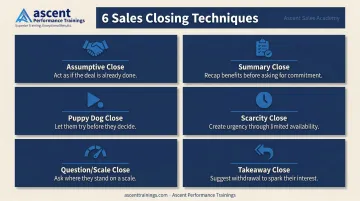
- The 6 techniques: Assumptive, Summary, Puppy Dog, Scarcity, Question/Scale, and Takeaway
- Match your technique to the buyer's situation — buying signals, deal stage, and unresolved objections
- Most closes fail because the groundwork wasn't done, not because the wrong script was used
- Post-deal reflection and structured coaching drive improvement — not just more reps
What Makes a Sales Closing Technique Actually Work?
No technique rescues a deal where the buyer doesn't trust you or can't see the value. Before you attempt any close, three things need to be true:
- Value is clear — the prospect understands specifically how your solution addresses their problem
- The right person is in the room — you're talking to someone with authority to say yes
- Objections are surfaced — major concerns have either been addressed or at least acknowledged
"Always Be Helping" Has Replaced "Always Be Closing"
Salesforce reports that 72% of sales reps say their role has become more consultative, and buyers are driving that shift. LinkedIn's State of Sales data found that 89% of buyers describe the sellers they ultimately buy from as "trusted advisors" — not persuaders, not pitchers.
When buyers see you as a trusted advisor, the close becomes a natural extension of that relationship — your job is to guide them to a confident decision, not maneuver them into one.
Closing Is a Series of Micro-Commitments
Guiding a buyer to a decision works because of what happened before the final ask — not during it. If the close feels like a high-stakes gamble, that's a signal you haven't been closing throughout the conversation.
Every "yes" you earn along the way — agreement on the problem, buy-in on the proposed solution, confirmation that your timeline works — makes the final ask feel like a logical next step rather than a pressure moment. Think of the close not as a single event but as the last in a series of small agreements that accumulate into a decision.
When reps skip this and save "the close" for the end, they're asking the buyer to make one giant leap. That's where deals stall.
6 Sales Closing Techniques That Work
Each technique below maps to a specific buyer situation. Match the method to the moment — the right close at the wrong time is just as costly as no close at all.
The Assumptive Close
Move the conversation forward as if the purchase decision has already been made. Instead of asking "Would you like to move forward?", you ask "How would you like to handle onboarding?" or "What's the best way to get the contract to your team?"
This technique projects confidence, reduces the perceived risk of deciding, and eliminates the awkward pause where buyers second-guess themselves.
When to use it: The prospect has shown strong buying signals, key objections have been addressed, and engagement is high throughout the conversation.
When NOT to use it: Early in the conversation, or with hesitant buyers who haven't yet verbally aligned on value. Used too soon, it reads as presumptuous and damages rapport fast.
Example script:
"Based on what we've covered today, it sounds like this addresses the gap in your Q3 pipeline. Let's talk about getting your team set up — what does your procurement process look like?"
The Summary Close
How it works: Before asking for commitment, recap the agreed-upon benefits, pain points you've addressed, and the outcomes the buyer confirmed they care about. Then transition naturally to the ask.
This works because it reconnects the buyer to their own reasons for saying yes — right before the moment of decision. In longer sales cycles, detail gets lost across multiple conversations and stakeholders. The summary close cuts through that noise.
When to use it: Complex deals, multi-stakeholder environments, or any situation where time has passed between conversations.
Example script:
"Let me quickly recap where we've landed. You came to us with three priorities: reducing ramp time for new hires, improving win rates in mid-market, and giving your managers better coaching tools. We've walked through how our program addresses each of those. Given that alignment, does it make sense to take the next step?"
The Puppy Dog Close
How it works: Offer a risk-free trial, pilot, or limited rollout. Let the prospect experience the product or service in their own environment before committing.
Direct experience builds attachment and eliminates fear of commitment in a way no pitch can replicate. Once someone has used something and seen value firsthand, the conversation shifts from "should we buy this?" to "how do we keep this?"
When to use it: Software, services, or any offering where the value becomes obvious through hands-on use. OpenView data shows median free-trial-to-paid conversion around 14% — meaningfully higher than alternatives — which signals that trial experience genuinely moves buyers.
Critical caveat: The trial conditions matter enormously. A poorly structured onboarding produces a mediocre experience that confirms the buyer's hesitation rather than eliminating it. Set the buyer up for a genuine win during the trial period.
Example script:
"Rather than asking you to commit based on our conversation alone, what if we ran a 30-day pilot with your team? You'll see exactly how this performs in your environment — and then we can decide together whether it makes sense to expand."
The Scarcity (Now-or-Never) Close
How it works: Create a concrete reason to act now — a time-sensitive offer, limited availability, or an incentive that expires. Kahneman and Tversky's prospect theory established that people feel the pain of a loss more acutely than the pleasure of an equivalent gain. Fear of missing out drives more action than the prospect of gaining something.
When to use it: End-of-quarter scenarios with genuine pricing windows, situations where capacity or availability is actually limited, or when a prospect has been deferring without a clear reason.
The non-negotiable rule: The scarcity must be real. LinkedIn's State of Sales data shows 48% of buyers cite misleading product or price information as an immediate deal killer. Manufactured urgency that the buyer can see through doesn't just lose the deal — it ends the relationship.
Example script:
"I want to flag that the current pricing structure is available through end of quarter. After that, we move to the revised rates. If the timeline works for you, acting now locks in a meaningful difference — I just want to make sure you have that information."
The Question/Scale Close
How it works: Ask the prospect to rate their interest or readiness on a scale of 1–10. This creates an honest, non-confrontational diagnostic that tells you exactly where the buyer stands — and more importantly, what's still in the way.
Why it works: It gives buyers permission to be honest without feeling like they're killing the deal. A "7" is useful information. A "yes" that's really a "7" is not.
How to use the answer: If they say 7, your response is: "That's helpful — what would it take to get from a 7 to a 10?" Their answer tells you precisely what objection you still need to handle.
When to use it: When you're receiving mixed signals and need clarity before attempting a harder close. This is a diagnostic tool first, a close second.
Example script:
"On a scale of 1 to 10, how confident are you that this is the right fit for your team right now? ... Okay, what would need to be true for that to be a 10?"
The Takeaway Close
How it works: Instead of pushing forward, you pull back. Suggest — genuinely — that the solution may not be the right fit, or that the prospect may not qualify for the terms you've discussed. When something feels like it might be taken away, buyers naturally reassess how much they actually want it — and hesitation often turns into clarity.
When to use it: When the prospect is clearly interested but stuck on price or delaying without articulating a real reason.
The essential caveat: Only use this if you genuinely believe there may be a fit issue worth exploring. Inauthenticity is obvious, and a buyer who feels manipulated won't just stall — they'll walk. This is not a bluff; it's a legitimate fit conversation.
Example script:
"I want to be honest with you — based on what you've described about your timeline and budget constraints, I'm not sure this is the right moment for us to move forward. I'd rather have that conversation now than have you invest in something that doesn't deliver. Can we talk through what's actually holding this up?"
How to Choose the Right Closing Technique
Elite closers don't memorize one script. They read the room and match their approach to what's actually happening in the conversation.
Practical matching framework:
| Situation | Best Technique |
|---|---|
| Strong buying signals, high engagement | Assumptive or Summary Close |
| Mixed signals, unclear objections | Question/Scale or Puppy Dog Close |
| Price sensitivity or unexplained stalling | Takeaway or Scarcity Close |
| Long cycle, multiple stakeholders | Summary or Question/Scale Close |
| Risk-averse buyer, high commitment barrier | Puppy Dog Close |
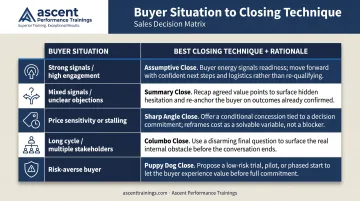
That framework only works, though, if you can accurately read the signals in front of you.
Reading the Room
Active listening is the real differentiator. LinkedIn identifies it as the top attribute buyers value in salespeople, and top performers consistently listen more than they speak during sales calls.
Strong buying signals:
- Questions about implementation timelines or onboarding
- Requests for references or case studies
- Discussion of internal approval processes
Weak or mixed signals:
- Vague, non-committal language ("we're still evaluating options")
- Repeated deferrals without specific reasons
- Minimal engagement with specifics
Shifting techniques mid-conversation when the first approach isn't landing is often necessary — and expected of a skilled closer. Buyers respond better to someone who adapts to their situation than to someone clearly working through a fixed sequence.
Common Mistakes When Closing a Sale
Three mistakes account for a disproportionate share of lost deals:
Closing too early — before value is established or objections surfaced. This creates resistance, not momentum. A buyer who isn't ready to say yes will default to "no" when pushed.
Never asking for the sale — waiting for the prospect to volunteer a commitment. Inertia kills deals. A confident, direct ask signals conviction and gives the buyer permission to say yes.
Using fake urgency — manufactured scarcity that buyers can detect immediately. Research consistently shows that misleading information is one of the fastest ways to lose a deal permanently. Only create urgency you can substantiate.
The Feature-vs-Outcome Trap
Sellers who describe what their product does lose to sellers who speak the language of what it means for the buyer. Every feature needs a corresponding business outcome the prospect has actually told you they care about.
Feature: "Our platform has automated reporting." Outcome: "Your managers get two hours back per week to redirect toward coaching their teams."
Buyers buy outcomes — not capabilities.
Ignoring Buying Signals in Both Directions
Pushing too hard when signals are weak creates friction. Failing to act when signals are strong lets deals drift. Both are costly.
Strong signals are specific: "When could we realistically be up and running?" Weak signals are vague: "This looks interesting — let me think about it." Learn the difference, and respond accordingly.
Avoiding these mistakes won't close every deal on its own — but they remove the self-inflicted obstacles that derail salespeople before the techniques even get a chance to work.
How to Keep Sharpening Your Closing Skills
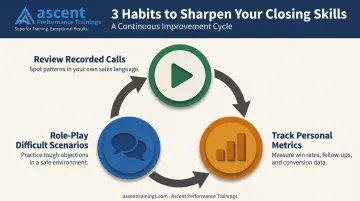
Closing improves through deliberate practice, not just experience. Three habits separate reps who develop quickly from those who plateau:
- Review recorded calls to identify the moments you missed — where signals appeared and weren't acted on, or where the close came too early
- Role-play difficult scenarios across different buyer types and objection patterns before you encounter them live
- Track your own metrics — close rate by stage, most common objection at close, average number of touches before a decision — to find patterns and gaps
Structured training accelerates this process. CSO Insights found that organizations with a dynamic sales coaching approach achieved a 55.2% average win rate — 8.8 percentage points above the study average. Working with a coach or structured program compresses the timeline from trial-and-error to genuine skill.
Ascent Performance Trainings builds its sales programs around that principle. Each engagement incorporates real-world role plays that simulate the pressure of actual buyer conversations, so reps practice under conditions that mirror the deals they're working.
The 8-week post-training reinforcement program goes further — weekly coaching touchpoints embed techniques into daily practice rather than letting them fade after the workshop ends. Founder Tim Carlisle's 30+ years of field experience across technology, financial services, and oil and gas shapes every aspect of the curriculum.
The most consistent closers treat every deal — wins and losses — as data. Bring that reflection into the next conversation, and the improvement compounds.
Frequently Asked Questions
What are the 5 closing techniques?
The most commonly cited five are: Assumptive, Summary, Puppy Dog, Scarcity/Now-or-Never, and Question/Scale Close. The right choice depends on the buyer's situation, deal stage, and which objections remain unresolved.
What are the 5 C's of sales?
The 5 C's of successful sales are Context, Clarity, Curiosity, Credibility, and Commitment. Each stage builds the trust and understanding that makes the final close feel natural rather than forced.
What is the 3-3-3 rule in sales?
The 3-3-3 rule is a prospecting framework, not a closing technique. It involves researching a prospect for 3 minutes, identifying 3 relevant insights, and crafting a 3-sentence outreach message — the groundwork that puts you in a position to close at all.
When is the right time to ask for the sale?
When the buyer has shown genuine interest, key objections have been addressed, and value is clearly understood. Waiting too long costs deals just as often as asking too early — a confident, well-timed ask gives buyers the clarity they need to commit.
How do you handle objections during the closing process?
Treat objections as requests for clarity, not roadblocks. Ask questions to surface the real concern, acknowledge it without dismissing it, and tie your response back to the outcomes the buyer has said they care about. The more precisely you understand the concern, the more effectively you can address it.
What is the difference between a hard close and a soft close?
Hard closes (Assumptive, Scarcity) are direct and assertive — they work when alignment is already high. Soft closes (Summary, Puppy Dog, Question/Scale) are consultative and gradual. Most modern B2B buyers respond better to soft closes that feel collaborative rather than pressured.