

The challenge isn't effort. It's that virtual selling is a genuinely different discipline. Buyers who once gave you an hour in a conference room are now one Slack notification away from mentally leaving your call. According to RAIN Group's 2024 global study of 528 buyers and sellers, 91% of sellers struggle to gain and keep buyer attention in virtual environments — and only 26% of buyers say sellers are skilled at virtual needs discovery.
This guide covers what virtual selling actually demands, the specific skills reps need, proven best practices, and how to build a training program that sticks.
TL;DR
- Virtual selling is now a permanent B2B channel — not a workaround
- The biggest skill gaps are attention management, discovery, and virtual relationship-building
- On-camera presence, structured communication, and deliberate follow-up are non-negotiable
- Strong virtual selling programs combine multiple learning modalities with post-training reinforcement
- Behavior change requires spaced practice and ongoing coaching — not one-off workshops
What Is Virtual Selling (And Why It's Here to Stay)
Virtual selling covers any part of the sales process conducted through digital channels — video calls, email, social media, asynchronous video, or online demos — rather than face-to-face meetings. It's not just the closing call; it spans prospecting, discovery, demos, negotiation, and follow-up.
McKinsey's 2022 hybrid sales research, based on more than 2,500 sales organizations, found that more than 90% of B2B enterprises planned to sustain structural changes supporting hybrid selling models. Their 2024 B2B Pulse data reinforces this: at any given stage of the buying journey, buyers split almost evenly across three preferences:
- In-person interaction — roughly one-third want face-to-face engagement
- Remote communication — roughly one-third prefer video or phone
- Digital self-service — roughly one-third want to research and decide independently
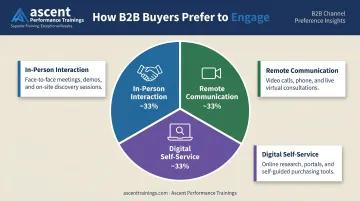
That split matters. Virtual selling isn't replacing in-person — it's now a permanent, parallel channel that every rep needs to execute well.
The challenge is that virtual selling demands more than a platform swap. It requires different preparation, different communication techniques, and a fundamentally different approach to building trust — which is why dedicated training isn't optional.
Virtual Selling vs. In-Person: Key Differences That Change How You Sell
Understanding what changes on screen helps reps stop applying in-person instincts to a context where they don't work.
Nonverbal Communication Takes a Back Seat
In a physical meeting, body language, micro-expressions, and energy do a lot of the persuasion work without the rep even realizing it. On screen, most of that disappears.
Stanford research on video fatigue found that videoconferencing creates significant nonverbal overload: apparent eye gaze in a nine-person video meeting runs roughly eight times higher than in-person, while faces appear at an uncomfortably close simulated distance.
Reps need to compensate deliberately: vocal tone, pacing, and word choice carry far more weight than they ever did in a room.
The Attention Economy Problem
In person, a seller can physically command a room. On a call, the buyer is one click away from their inbox, their phone, or another browser tab. There's no ambient social pressure to stay engaged.
This makes meeting structure and engagement techniques more important than most reps account for. Without deliberate design, virtual meetings drift — and buyers mentally check out while technically still on the call.
Relationship-Building Happens on the Clock
The informal rapport that builds before and after in-person meetings (small talk in the lobby, lunch after a product demo) simply doesn't exist virtually. Every trust-building moment has to happen within the structured time of the call itself.
Reps who rely on social warmth to close deals often find virtual selling cold and transactional. The answer isn't more small talk on Zoom — it's engineering trust through deliberate behaviors:
- Following up within 24 hours with clear next steps
- Personalizing each touchpoint to the buyer's stated priorities
- Showing consistency between what you say and what you do
- Using between-call communication to add value, not just check in
The Core Virtual Selling Skills Every Rep Needs
On-Camera Presence and Professional Setup
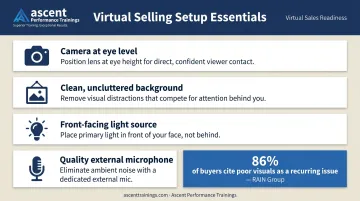
How a rep appears on screen shapes buyer perception before a word is spoken. The basics matter more than most reps admit:
- Camera at eye level — looking down at a laptop signals disengagement
- Clean, uncluttered background — visual noise is distracting and undermines credibility
- Good lighting from the front — dark or backlit video reads as low-effort
- Quality microphone — muffled audio kills meetings faster than any bad slide
These aren't vanity details. RAIN Group's research found that 89% of buyers report experiencing technology problems with sellers in virtual meetings, and 86% cite poor or absent visuals as a recurring issue. A professional setup signals respect for the buyer's time.
Virtual Communication and Active Listening
Clear, structured communication is harder on screen because nuance disappears. Silence reads differently, reactions are delayed, and "I think they're following" is harder to gauge.
Effective virtual sellers:
- Lead every call with a clear agenda — buyers need a map when they can't read the room
- Signal transitions explicitly — "Let's move to the demo now" rather than just moving
- Ask deliberate check-in questions throughout — not just at the end
- Use verbal acknowledgment in place of nodding — "That makes sense" and "Good point" do real work when physical cues are absent
- Summarize back what the buyer has said before responding — it signals listening and buys thinking time
Engaging Presentations and Demo Skills
Virtual presentations have to work harder because the seller's physical presence no longer holds the room. A slide deck that was fine in a boardroom becomes passive and forgettable on a screen.
Techniques that make the difference:
- Strategic animation to control pacing and keep attention moving
- Screen annotation to draw the eye to what matters in real time
- Interactive polls mid-demo to break passive viewing and re-engage
- Short, grounded stories that connect product capabilities to real buyer outcomes
Every technique should give the buyer something to do, not just watch.
Digital Relationship-Building and Trust Creation
Virtual trust is built between calls, not just on them. A generic recap email after every meeting is a missed opportunity — buyers remember the reps who made them feel seen after the call ended.
What actually moves the needle:
- Personalized follow-up video messages tied to something specific from the call
- Sharing relevant content the buyer didn't ask for but needed
- Prompt, reliable follow-through on every commitment made
- Brief check-ins between formal meetings that add value without asking for anything
Objection Handling Without Visual Cues
Strong relationships reduce friction — but they don't eliminate objections. When cameras are off, objections become harder to detect and easier to misread. A 2024 Journal of Selling study of B2B technology sellers found that **salesperson concern about buyers not turning on cameras was negatively related to sales performance** (beta = -0.316). Camera-off buyers create a real power imbalance, making it harder to gauge whether the prospect sees value.
When visual feedback is limited, reps need to:
- Ask more explicit questions to surface hesitation — "Where are you at on this?" rather than waiting for body language
- Use structured empathy responses — acknowledge the concern before addressing it
- Resist the urge to fill silence with more pitch; pause and invite the buyer to respond
Best Practices for Virtual Selling Success
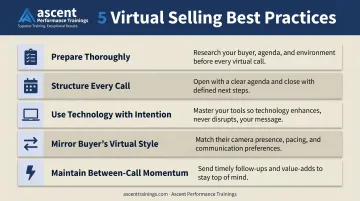
RAIN Group found 83% of buyers report sellers being unprepared in virtual settings. There's no small talk to cover a weak start. Research the buyer's business, prepare a clear agenda, and send pre-read materials before the call so the meeting stays focused on conversation.
Strong preparation sets the tone — but structure carries it through. Open every virtual call with an explicit agenda, manage time deliberately, and close with a defined next step. Without physical transitions to signal progress, buyers need to hear "where we are" and "where we're going" stated out loud.
These five practices separate consistent virtual closers from reps who struggle once the camera turns on:
- Use technology with intention. Screen sharing, virtual whiteboards, and collaborative documents engage buyers when chosen deliberately — not layered on for the sake of it. Two or three tools used well beat a cluttered tech stack every time.
- Mirror the buyer's virtual style. Some buyers want tight, 30-minute Zoom calls. Others prefer detailed follow-up emails or async voice notes. Skilled virtual sellers pick up on these preferences fast and adapt rather than running every engagement the same way.
- Maintain momentum between calls. Virtual deals stall more easily — there's no physical presence to sustain urgency. Value-add follow-ups, shareable content, and brief check-ins keep deals moving without requiring a formal meeting each time.
How to Structure a Virtual Selling Training Program
Start With Skills Diagnosis
Effective programs don't start with content delivery — they start by identifying where individual reps actually have gaps. Generic training delivered to everyone wastes time and produces limited behavior change. A structured skills assessment lets you target the specific weaknesses: on-camera confidence, virtual objection handling, discovery questioning, or something else entirely.
Use Multiple Learning Modalities
Virtual selling skills aren't developed by watching a course. They require a blend of formats:
- Live instructor-led sessions for practice, feedback, and scenario work
- Self-paced modules for concepts, frameworks, and review
- One-on-one coaching for targeted gap closure at the individual level
Ascent Performance Trainings delivers this integrated model through live virtual micro-learning sessions (60–90 minutes on Zoom), a 24/7 AI-personalized online learning platform, and 1:1 coaching — structured so skills get embedded, not just introduced.
Build in Deliberate Practice On-Camera
Virtual selling requires rehearsal in the actual medium. Practicing objection handling in a classroom is useful. Practicing it on a video call, where silence lands differently and visual feedback is limited, exposes entirely different gaps.
Core practice components for any virtual selling program:
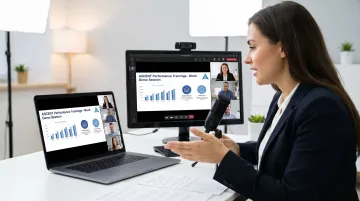
- Mock virtual demos run in the same platform reps use with buyers
- On-camera role-plays with recorded playback for self-review
- Structured feedback sessions tied to specific skill criteria
Prioritize Post-Training Reinforcement
ATD cites the Ebbinghaus forgetting curve: approximately 72% of learned information is forgotten within two days without reinforcement. A single training event, no matter how good, fades fast.
Effective reinforcement looks like:
- Spaced repetition of key concepts over weeks, not a one-day refresher
- Brief video reminders tied to specific skills
- Ongoing coaching check-ins to address application challenges
Ascent Performance Trainings includes 8 weeks of post-training support with weekly reinforcement videos and monthly one-on-one coaching sessions — specifically designed to close the gap between training and on-the-job application. That sustained cadence is what converts a training event into a durable skill.
What to Look for in a Virtual Sales Training Provider
Choosing the wrong provider is expensive — not just financially, but in the time it costs your team and the momentum you lose.
Three criteria separate credible providers from generic ones:
Industry experience and methodology. Look for providers with a documented track record across different industries and roles. Check for real credentials, industry depth, and whether their approach is built around measurable behavior change. Ascent's programs, for example, draw on over 30 years of field experience across technology, financial services, oil and gas, and other complex B2B environments.
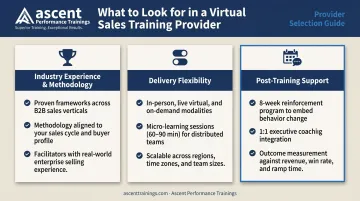
Delivery flexibility. The best providers offer multiple formats — live virtual, self-paced, and coaching — and can customize content to your team's specific sales cycle, industry, and skill level. Complex B2B environments have nuances that one-size-fits-all programs miss.
Post-training support. This is the question most buyers forget to ask: what happens after the formal training ends? Providers committed to outcomes will give you a concrete answer — reinforcement tools, coaching availability, and progress tracking. Vague answers here typically mean vague results.
Frequently Asked Questions
What is the difference between virtual selling and remote selling?
Virtual selling refers to using digital tools and channels throughout the sales process — video calls, email, asynchronous video, and online demos. Remote selling typically describes where the rep is physically located. All virtual selling involves remote work, but remote sellers can still conduct in-person client visits.
Can virtual sales training be as effective as in-person training?
Yes — when it's designed well. Virtual training that combines live instruction, structured practice, and post-training reinforcement can match or exceed in-person results. What separates effective programs from forgettable ones is deliberate design, coached practice, and follow-through that extends beyond the session itself.
How do you build rapport with buyers in a virtual setting?
Open calls with brief, genuine conversation before jumping into agenda items. Be consistent with follow-ups, use personalized video messages tied to specific call moments, and demonstrate real curiosity about the buyer's specific challenges — not just their use case.
What technology do sales reps need for effective virtual selling?
A reliable video conferencing platform, a quality camera and microphone, a strong internet connection, and solid familiarity with screen sharing and presentation tools. Proficiency reduces friction and signals professionalism — buyers notice when a rep fumbles with basic setup.
How long does it take to develop strong virtual selling skills?
Camera presence, meeting structure, and basic listening techniques improve noticeably within a few weeks of focused practice. Trust-building, virtual objection handling, and deeper on-camera confidence typically take several months of deliberate practice and ongoing coaching to solidify.
How do you measure the ROI of virtual sales training?
Track conversion rates, deal velocity, quota attainment, and ramp time before and after training — then pair those with qualitative signals like manager observations and rep confidence scores. The Kirkpatrick model offers a reliable structure: measure reaction, learning, behavior change, and business results in sequence. Ascent's engagements are scoped against these KPIs from the outset, so there's a clear baseline to measure against.