Introduction
Poor customer service is an expensive problem. According to Qualtrics XM Institute, organizations globally put $3.7 trillion annually at risk due to bad customer experiences — and 63% of consumers will switch to a competitor after just one negative interaction.
Most managers respond by telling agents what to do differently. That reactive correction is managing. Coaching is something else entirely: a deliberate, ongoing process of building the skills, habits, and judgment that make an agent consistently excellent — not just temporarily compliant.
This guide covers everything needed to build a real coaching program: the skill areas that matter most, six proven tactics, three frameworks to structure your sessions, and how to make the results last beyond the training room.
TL;DR
- Skills develop through consistent coaching — not one-off corrections after something goes wrong
- Effective coaches use real data, roleplay, structured feedback, and regular one-on-ones
- Focus on empathy, active listening, problem-solving, communication, and product knowledge
- A consistent cadence with clear action plans drives measurable improvement
- Lasting behavior change comes from post-session reinforcement, not the session alone
Why Coaching Customer Service Teams Drives Real Business Results
Coaching isn't a soft investment. It has direct, measurable impact on the metrics that matter most: agent retention and the quality of every customer interaction.
A 2024 Metrigy study found that 97% of contact center leaders believe agent tenure directly affects customer satisfaction, with 46% reporting that longer-tenured agents deliver higher CSAT scores. Consistent coaching is what creates that connection.
The Retention Equation
High turnover is one of the most preventable costs in customer service. Replacing a single contact center agent can cost over $35,000 once recruiting, onboarding, and training are factored in. Agents who feel genuinely supported stay longer. Those who don't take their institutional knowledge out the door with them.
Coaching directly reduces this cycle. When agents see a clear path for growth, receive specific feedback, and feel invested in, tenure increases. That stability compounds: experienced agents handle complex interactions faster, escalate less, and resolve issues on the first contact more often.
The Brand Touchpoint Argument
Every customer interaction is a brand impression. A single poorly handled call can generate a negative review that hundreds of potential customers read before deciding whether to buy. Excellent service creates the opposite effect — loyal customers who refer others and return repeatedly.
Salesforce research shows that 88% of customers are more likely to purchase again when a company meets their service expectations. Coaching is what makes meeting those expectations repeatable, regardless of which agent picks up.
What to Focus on When Coaching Customer Service Teams
Scattering feedback across every skill at once leads to overwhelm and no real change. The most effective coaching targets specific, defined areas one at a time.
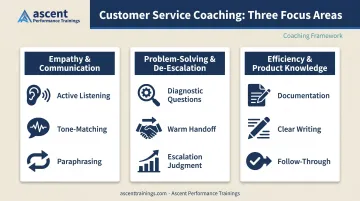
Customer Communication and Empathy
Agents need to open conversations warmly, acknowledge the customer's emotional state before jumping to solutions, and maintain a calm, professional tone throughout. Active listening is the core skill here — and it goes well beyond staying quiet while someone talks.
Effective active listening includes:
- Paraphrasing the customer's issue back to confirm understanding
- Asking clarifying questions before proposing solutions
- Avoiding interruptions, even when the answer is obvious
- Matching tone to the customer's emotional state (calm when they're frustrated, responsive when they're urgent)
Problem-Solving and De-Escalation
Two failure modes show up consistently: agents who escalate too quickly due to lack of confidence or knowledge, and agents who never escalate due to ego or poor judgment. Coaching should help agents distinguish between the two.
Good problem-solving coaching builds these habits:
- Ask the right diagnostic questions before jumping to a solution
- Explore available options before transferring the call
- Recognize when a warm handoff, rather than a blind transfer, is the right move
Efficiency, Accuracy, and Product Knowledge
69% of service agents report difficulty balancing speed and quality. In most cases, that's a skill gap, not a scheduling problem. Coaching on efficiency should address:
- Accurate, complete documentation during and after interactions
- Clear written communication (especially for email and chat)
- Follow-through so customers never have to repeat themselves
Product and process knowledge gaps are often the root cause of long handle times and unnecessary escalations. When agents don't know the answer, they stall, transfer, or guess.
Coaching should surface these gaps and address them with targeted resources — not a vague directive to "know the product better."
Proven Tactics for Coaching Customer Service Teams
Tactic 1: Ground Feedback in Data, Not Impressions
"Your calls need to improve" is not coaching. "Your first-call resolution rate dropped this month — let's pull a recording and look at why" is.
Feedback grounded in specific data — CSAT scores, call recordings, resolution rates, handle time trends — is more credible and harder to dismiss. It also gives agents a way to track their own progress over time, which builds intrinsic motivation.
Tactic 2: Use the Feedback Sandwich Intentionally
Open with a genuine positive observation. Address the development area in the middle. Close with another real strength or a forward-looking positive statement. This isn't about softening criticism — it's about keeping agents receptive rather than defensive.
The key word is genuine. If the positives feel like padding, agents notice immediately and stop trusting the feedback.
Tactic 3: Make Roleplay a Regular Practice
Roleplay lets agents practice difficult scenarios — irate customers, complex complaints, escalation decisions — before those situations happen live. The low-stakes environment is the point: mistakes in roleplay cost nothing.
An effective structure:
- Coach models the ideal behavior for the scenario
- Agent attempts the scenario
- Immediate debrief with specific observations
Ascent Performance Trainings' Customer Service Academy builds roleplay directly into the program design, pairing real-world scenarios with motivational coaching so agents develop both the skills and the confidence to handle difficult interactions before they face them on a live call.
Tactic 4: Praise Publicly, Coach Privately
Recognition in front of peers motivates the individual and signals to the team what good looks like. Criticism delivered publicly does the opposite — it damages trust and signals that mistakes are something to be embarrassed about rather than worked through.
Tactic 5: Ask Agents to Self-Assess First
Before giving your feedback, ask the agent to review their own interaction. What did they think went well? Where did they feel uncertain?
Self-assessment before feedback delivers three real advantages:
- Agents who name their own gaps are more motivated to close them
- Defensiveness drops when the agent has already acknowledged the issue
- Regular self-review builds the self-awareness that separates good agents from great ones
Tactic 6: Don't Wait for the Monthly Check-In
If a behavior needs correction, waiting three weeks to address it means that behavior is repeated dozens of times before it changes. Timely, in-context feedback — a quick note after a call, an annotated recording, a brief conversation the same day — reinforces learning while the interaction is still fresh.
Save scheduled sessions for deeper development work. Use real-time feedback for course correction — where it actually sticks.
Coaching Models and Frameworks to Guide Your Sessions
A structured model keeps coaching sessions purposeful. Without one, sessions drift toward vague conversation rather than concrete development.
The GROW Model
Goal → Reality → Options → Will/Way Forward
This model keeps the agent in the driver's seat rather than making coaching a top-down lecture:
- Goal: What does the agent want to achieve or improve?
- Reality: An honest assessment of current performance against that goal
- Options: What approaches could close the gap?
- Will/Way Forward: What specific actions will the agent commit to, and by when?
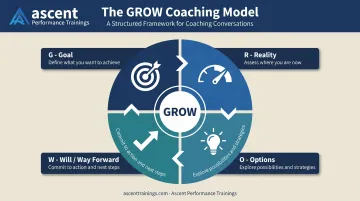
GROW is widely used in contact centers because it builds ownership. Agents arrive at their own action plan through structured conversation, which drives stronger commitment than top-down direction.
Two Stars and a Wish
A simpler approach suited for shorter, more frequent check-ins:
- Two genuine strengths observed in the agent's recent work
- One clear area for growth
This works well for weekly touchpoints where there isn't time for a full GROW session, but consistency still matters.
The THINK Model
THINK functions as a coaching checklist, particularly useful for evaluating the quality of your own feedback before delivering it. The acronym gives coaches five filters to run through before any difficult conversation:
- True: Is the feedback accurate and grounded in observed behavior?
- Helpful: Does it serve the agent's development?
- Inspiring: Does it motivate rather than deflate?
- Necessary: Is it worth raising right now?
- Kind: Is the delivery respectful and constructive?
Running through these filters keeps feedback honest without being reactive.
Building a Coaching Program That Actually Sticks
A single coaching session produces a good conversation and an action plan that often gets forgotten by the following week. Agents revert to old habits because behavior change takes time — research suggests an average of 66 days to form a new habit, with a range of 18 to 254 days depending on the individual and complexity of the behavior.
Coaching is a process. It requires structure, repetition, and accountability.
Set SMART Goals in Every Session
Goals set during coaching should connect directly to the metrics the team is already measured on. A useful example: "Reduce unnecessary escalations by 15% over the next 30 days by using the three diagnostic questions we practiced before transferring."
That goal is Specific, Measurable, Achievable, Relevant, and Time-bound. It also gives the coach a clear signal at the next session — did it happen or not?
Use a QA Scorecard to Keep Coaching Objective
A shared scorecard ensures all agents are evaluated against the same criteria. This matters for two reasons: it removes subjectivity from the coach's assessments, and it gives agents a transparent view of what "excellent" actually looks like.
Agents who have access to their own scorecard can self-evaluate before formal sessions — which connects directly to the self-assessment tactic above.
Post-Session Reinforcement Is Where the Work Happens
The coaching session surfaces the problem and identifies the solution. The real skill development happens in the days and weeks that follow. Without reinforcement, even a strong session rarely produces lasting behavior change.
Ascent Performance Trainings' 8-week post-training reinforcement program is built around this reality. Participants receive weekly AI-personalized content with practical application reminders, plus monthly 1:1 coaching sessions to address individual challenges and track progress against goals. That sustained cadence is what converts classroom learning into on-the-job behavior change.
Measure Coaching Effectiveness Over Time
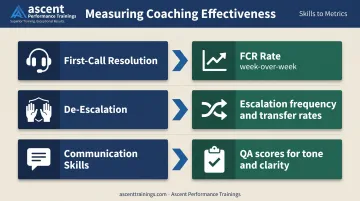
Track the metrics tied to coached skill areas before and after the coaching period. Match your tracking to the skill being coached:
- First-call resolution coaching → track FCR rate week over week
- De-escalation coaching → monitor escalation frequency and transfer rates
- Communication skills coaching → review QA scores for tone and clarity
This feedback loop tells coaches whether their approach is working — and where to recalibrate.
Common Mistakes to Avoid When Coaching Customer Service Teams
Most coaching programs don't fail because of bad intentions — they fail because of predictable, avoidable patterns. Watch for these three:
Mistake 1 — Being vague. "You need to be more empathetic" doesn't work without a specific example, context, and a concrete alternative. Vague feedback creates confusion, not improvement. Always attach feedback to a real moment and a specific behavior change.
Mistake 2 — Only coaching underperformers. Top performers plateau without challenge and recognition. Neglecting high performers signals that excellence goes unacknowledged — a fast path to losing your best people. Strong performers need coaching that raises their ceiling, not just maintains it.
Mistake 3 — Skipping follow-through. The most common coaching failure isn't a bad session — it's a good session with no follow-up. When action plans never get revisited, agents learn that commitments made in coaching don't actually matter. Build a simple check-in cadence: even a 10-minute weekly touchpoint keeps progress visible and accountability real.
Frequently Asked Questions
What are the Five C's of customer service?
The Five C's are Care, Competence, Culture, Consistency, and Communication. In practice, these map to the core coaching disciplines: empathy-building (Care), product knowledge (Competence), and active communication skills.
What is the 10/5/3 rule in customer service?
The 10/5/3 rule is a face-to-face acknowledgment framework: make eye contact at 10 feet, smile at 5 feet, and verbally greet the customer at 3 feet. It's primarily applied in retail and hospitality environments where physical proximity drives the first impression.
What are the 5 P's of customer service?
The 5 P's are Prepared, Professional, Positive, Patient, and Proactive. Coaching on patience and proactivity in particular has an outsized impact on interaction quality and consistency.
What is the difference between customer service training and coaching?
Training is the structured delivery of knowledge and skills — typically in a classroom or workshop format. Coaching is the ongoing, personalized process of applying and reinforcing those skills in real work situations. Training gives agents the knowledge; coaching is what turns that knowledge into reliable behavior on the job.
How often should you coach customer service agents?
For most teams, weekly or bi-weekly 1-on-1s combined with real-time feedback between sessions is the baseline. Increase frequency during onboarding or when an agent is closing a specific performance gap. Once skills stabilize, sessions can taper accordingly.
What makes a good customer service coach?
The most effective coaches combine specific, data-backed feedback with genuine curiosity about the agent's development. Key traits include active listening, consistency in follow-through, and a real investment in the agent's growth — not just their performance numbers.