Introduction
Most leaders were trained to direct, decide, and deliver. For decades, individual accountability, clear chains of command, and decisive authority defined what good leadership looked like. Today's organizations look nothing like the ones those models were built for.
Hybrid teams span time zones. Cross-functional projects require leaders to align people who don't report to them. A multigenerational workforce expects to be involved in decisions, not just informed of them.
Without intentional development, managers default to command-and-control habits even when they genuinely want to collaborate — and the results show up as disengaged teams, stalled execution, and cultural misalignment.
Gallup's State of the Global Workplace report puts the stakes in plain terms: global employee engagement fell to 20% in 2025, with an estimated $10 trillion in lost productivity. A significant part of that gap traces back to how leaders communicate, include, and share ownership with their teams.
This guide covers what collaborative leadership means, the skills that make it work, how to build a development program that produces lasting behavior change, and the real barriers most organizations run into along the way.
TL;DR
- Collaborative leadership replaces directive authority with shared decision-making, open communication, and collective accountability
- It's increasingly essential in hybrid, matrixed, and cross-functional environments where positional authority alone can't drive alignment
- Core skills like active listening, influence without authority, and conflict facilitation are learnable with the right program structure
- Effective programs follow the 70-20-10 framework and include post-training reinforcement to convert knowledge into behavior
- Silos, resistance to vulnerability, and ambiguous decision rights can be overcome with structured program design and visible senior leadership modeling
What Is Collaborative Leadership?
Defining the Approach
Collaborative leadership is an approach where decision-making is shared, communication is open, and responsibility for results is collective. The defining factor is process, not title or position.
As David Chrislip and Carl Larson framed it in their foundational work, authentic collaboration emerges when the right people are brought together with good information: those affected by an issue, those with power to act or block action, and those who genuinely care about the outcome.
In practice, the collaborative leader's role centers on three things:
- Engaging collective intelligence across the team
- Aligning people around shared goals before direction is set
- Sustaining momentum, especially where formal control structures are limited
Authority is exercised through influence rather than positional power.
Collaborative vs. Traditional Leadership
The distinction isn't about eliminating hierarchy. It's about how authority is exercised.
| Dimension | Traditional Leadership | Collaborative Leadership |
|---|---|---|
| Decision-making | Top-down directives | Co-created with meaningful input |
| Compliance driver | Positional authority | Trust and buy-in |
| Conflict handling | Avoided or suppressed | Facilitated constructively |
| Accountability | Individual | Shared ownership |
Collaborative leadership doesn't mean every decision goes to a committee vote. Direction and accountability still exist. The difference is that those closest to the work have genuine input before direction is set, and shared ownership of outcomes replaces assigning blame when results fall short.
Why Collaborative Leadership Development Matters Now
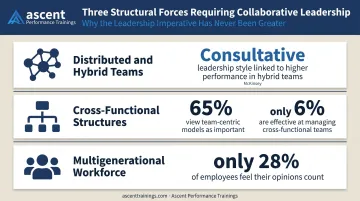
Three structural forces have made this a strategic priority, not a cultural preference.
- Distributed and hybrid teams. McKinsey finds that top-performing hybrid organizations excel at consultative and supportive leadership practices. When teams are spread across locations, leaders must build trust and shared purpose deliberately — proximity no longer does that work for them.
- Cross-functional structures. Deloitte reports that 65% of respondents see team-centric and network-based models as important or very important — yet only 6% say their organization is very effective at managing cross-functional teams. Closing that gap requires leadership capability, not structural redesign.
- A multigenerational workforce. Today's employees expect a voice in decisions. Gallup data shows only 28% of U.S. employees strongly agree their opinions count at work — a figure that ties directly to engagement, retention, and discretionary effort.
The performance case is equally clear:
- Reduced silos and faster execution when cross-functional input is sought before direction is set
- Higher engagement when people feel heard and have genuine ownership over outcomes
- Stronger psychological safety, which research links to innovation, information sharing, and team learning behavior
- Lower turnover, given that trust in leadership is one of the strongest predictors of retention
Core Skills Every Collaborative Leader Must Develop
Active Listening and Empathic Communication
Collaborative leaders prioritize understanding over responding — which is what creates the psychological safety that allows team members to surface problems early, share dissenting views, and engage fully rather than just comply.
Active listening is a trainable skill, not a fixed personality trait. Research from StatPearls/NCBI confirms that effective communication requires ongoing practice. The Center for Creative Leadership identifies six core techniques:
- Paying full attention
- Withholding judgment
- Reflecting back what you heard
- Clarifying ambiguities
- Summarizing key points
- Sharing your own perspective after listening
CCL also notes that employees' perception of being listened to is twice as high when a leader listens and takes action compared to listening alone.
Influence Without Authority
In matrixed and cross-functional environments, formal reporting lines often don't exist. Collaborative leaders build credibility through transparency, consistency, and shared purpose rather than positional power.
Three behaviors that demonstrate this in practice:
- Naming stakes clearly — link the work to outcomes that matter to the other person's team, not just your own
- Reciprocity — giving resources, information, or support before asking for cooperation
- Consistency over time — following through repeatedly until credibility accumulates into trust
Deloitte identified influence without authority as a defining leadership capability — and most organizations still have a meaningful gap between how much they need it and how well they've developed it.
Conflict Facilitation and Constructive Resolution
Conflict in collaborative teams isn't a failure signal. It means people care and that competing ideas are surfacing — precisely what you want before major decisions.
The collaborative leader's role is to facilitate rather than avoid conflict: naming the tension, creating space for all positions to be heard, and steering toward solutions that integrate the best of competing views. Suppressing disagreement to maintain surface harmony produces decisions that lack buy-in and implementation that stalls.
Trust-Building Behaviors
According to HBR's research on the neuroscience of trust, people at high-trust companies report 50% higher productivity, 76% more engagement, and 40% less burnout compared to low-trust organizations. Trust isn't a soft value — it's a measurable performance driver.
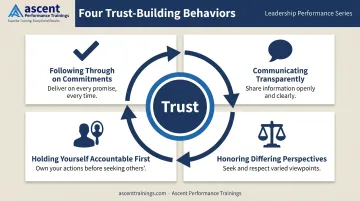
Trust builds through specific, repeatable behaviors:
- Following through on commitments, consistently
- Communicating transparently about decisions and their rationale — not just the what but the why
- Honoring differing perspectives without dismissing them
- Holding yourself publicly accountable before holding others accountable
Shared Vision and Participatory Decision-Making
Collaborative leaders bring people into the why behind organizational goals and co-develop definitions of success with their teams. This doesn't mean every decision requires full consensus. The practical distinction:
- Decisions requiring broad input: Strategic direction, cross-functional priorities, culture-shaping choices
- Decisions requiring clear authority: Time-sensitive calls, situations requiring a single accountable owner, escalated conflict resolution
The skill is knowing which mode applies — and communicating the process clearly before the decision is made, not just after.
How to Build a Collaborative Leadership Development Program
Start with a Leadership Culture Audit
Before designing any program, assess what leadership actually looks like in your organization today. Diagnostic questions that surface the gaps:
- How are decisions made in practice — who has input, and at what stage does it happen?
- Where does communication flow freely, and where does it consistently stall?
- What behaviors get recognized and rewarded — individual achievement or collective wins?
The answers often reveal that an organization says it values collaboration while its systems reward the opposite. That misalignment has to be named before development can address it. Ascent Performance Trainings incorporates DISC and EQ assessments into the opening phase of leadership engagements to establish this behavioral baseline before program content begins.
Apply the 70-20-10 Development Framework
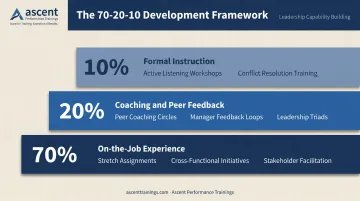
The 70-20-10 model was developed by Morgan McCall, Michael Lombardo, and Robert Eichinger at the Center for Creative Leadership. It describes how leadership development is most effective when:
- 70% comes from on-the-job challenges and real-project experience
- 20% comes from coaching, mentoring, and peer feedback
- 10% comes from formal instruction and structured training
This framework matters especially for collaborative leadership because the skills involved — trust-building, conflict facilitation, influence — can't be mastered in a classroom. They require practice in live, high-stakes situations where the outcome actually matters.
Design each layer deliberately:
- 70% — Stretch assignments: Lead a cross-functional initiative, facilitate a difficult stakeholder alignment session, or sponsor a project with no direct reports on the team
- 20% — Peer coaching and feedback: Structured peer coaching circles, manager feedback loops, and leadership triads where participants give and receive candid input
- 10% — Formal instruction: Facilitated workshops on active listening, conflict resolution, and influence — the foundational knowledge layer
McKinsey's research on capability building found that adults recall nearly seven times more content when learning by doing, and that activities closely resembling participants' day jobs outperform abstract learning. The 70-20-10 structure is designed around exactly that insight.
Choose Multi-Modal Learning Delivery
With a framework in place, the next decision is how to deliver it. No single format builds collaborative leadership on its own. Effective programs combine:
- In-person workshops for immersive, experiential practice through role plays and real-world simulations
- Live virtual sessions (60–90 minutes) for accessible, interactive skill practice across distributed teams
- 1:1 coaching for personalized feedback on the specific collaborative challenges leaders face in their organizations
- Self-paced modules for foundational knowledge and just-in-time reference
The Ascent Leadership Academy's 10-week program delivers exactly this multi-modal structure — integrating real-world coaching, interactive workshops, and practical leadership frameworks across in-person, virtual, and on-demand formats. Repeating the same skills across different contexts is what converts one-time exposure into habitual application.
Build in Measurable Reinforcement and Accountability
Most behavior change happens in the weeks and months after training ends, when leaders face real situations and decide whether to apply new skills or default to old patterns. Programs without structured post-training reinforcement consistently underperform those that build it in.
Ascent's post-training model includes eight weeks of weekly video touchpoints and monthly one-on-one coaching sessions specifically designed to maintain momentum after the program ends — ensuring skills compound rather than fade.
For tracking collaborative leadership progress, use lead indicators rather than lagging ones:
- Frequency of cross-functional input sought before major decisions are made
- Team members' reported sense of psychological safety (tracked through internal team check-ins or engagement surveys your organization already runs)
- Degree of shared ownership over project outcomes, reflected in how accountability is discussed in team meetings
Structure accountability milestones at 30, 60, and 90 days post-program, with specific behavioral commitments tied to each checkpoint.
Overcoming Common Barriers to Collaborative Leadership
Most organizations hit the same three walls when trying to build collaborative leadership — and none of them are about skills. They're about structure, incentives, and identity.
Resistance to Vulnerability and Shared Authority
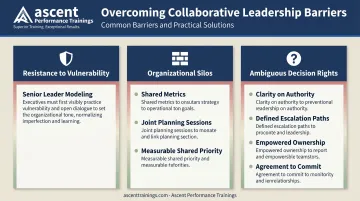
Leaders who built their careers through individual expertise often experience collaborative processes as a threat to credibility. The most effective counter is modeling from the top: when senior leaders visibly seek input, acknowledge uncertainty, and credit others publicly, it redefines what strength looks like at every level below them. Research on leader inclusiveness — inviting and appreciating others' contributions — links this behavior directly to psychological safety and team engagement.
Organizational Silos and Misaligned Incentives
When teams are rewarded solely for individual departmental performance, collaboration across boundaries stalls regardless of anyone's intentions. Only 28% of organizations award performance rewards based on measurable team metrics, according to Deloitte — which means most incentive structures actively work against the collaborative behaviors programs are trying to build.
Address this by:
- Creating shared outcome metrics that span teams or functions
- Establishing formal cross-functional touchpoints like joint planning sessions
- Positioning collaboration as a measurable business priority, not a cultural nicety
Ambiguity in Roles and Decision Rights
Collaboration breaks down fastest when people don't know who owns what. Before any collaborative initiative begins, establish explicit agreements:
- Who makes which categories of decisions?
- How are disagreements escalated and by whom?
- What communication norms apply — frequency, format, who needs to be in the room?
- How is accountability shared when outcomes are collective?
Without these agreements in place upfront, ambiguity fills the gap — and ambiguity erodes trust faster than any conflict.
Frequently Asked Questions
What should be included in a leadership development program?
A well-structured program covers self-assessment (using tools like DISC or EQ), structured learning across the 70-20-10 model, and post-training reinforcement through peer coaching and accountability check-ins. Measurement should track behavioral outcomes, not just training completion.
What is an example of a leadership development program?
A strong example combines a facilitated workshop on collaborative leadership skills with individual coaching sessions and self-paced learning modules. Eight weeks of post-training reinforcement through weekly touchpoints and monthly coaching embeds the skills into daily practice — the model used in Ascent's Leadership Academy.
What are the 5 C's of leadership development?
Several frameworks use the "5 C's" label with different components, and no single standard version dominates the field. Common elements across versions include Competence, Confidence, Commitment, Connection, and Character or Clarity — used as a design checklist to develop the whole leader, not just isolated skills.
What is the 70-20-10 rule in leadership?
The 70-20-10 rule holds that 70% of leadership development comes from on-the-job challenges, 20% from coaching and mentoring, and 10% from formal training. For collaborative leadership, this ratio matters most: the key behaviors require practice in live situations, not just classroom exposure, to stick.
How is collaborative leadership different from traditional leadership?
Traditional leadership relies on positional authority and top-down decision-making. Collaborative leadership operates through influence, shared decision-making, and collective accountability. The two aren't mutually exclusive, and direction and accountability still exist, but collaborative approaches consistently produce stronger team engagement and more adaptive organizational performance.
What are the biggest barriers to collaborative leadership?
The three most common barriers are resistance to vulnerability and loss of individual authority, organizational silos reinforced by misaligned incentives, and ambiguity about roles and decision rights. Each can be addressed through intentional program design, realigned incentives, and senior leaders who visibly model the behaviors they expect.