Introduction
Managing a hybrid team sounds straightforward until you're actually doing it. Suddenly you're tracking performance across two completely different work environments, navigating the awkward silence of a video call where remote participants can't read the room, and wondering whether your in-office employees are getting more face time — and more opportunities — than your remote counterparts.
Generic leadership training wasn't built for this. Most programs developed before 2020 assume a leader can walk the floor, read body language, and course-correct in real time. That worked then. It doesn't now.
Gallup reports that 52% of remote-capable U.S. employees currently work hybrid, and that number has stabilized rather than retreated. Hybrid has become the permanent operating model for most mid-market and enterprise teams. Leaders still managing as if everyone's in the same room are losing ground.
This guide breaks down the best leadership training programs built specifically for hybrid teams — what separates effective programs from generic ones, which features to prioritize, and how to match a program to your organization's structure and goals.
TL;DR
- Hybrid leaders need a distinct skill set: managing by outcomes, recognizing proximity bias, and communicating inclusively across in-person and remote channels
- The strongest programs combine multiple delivery formats with post-training reinforcement, because skills fade quickly without structured follow-through
- Programs reviewed include Ascent Performance Trainings, CCL, Dale Carnegie, Coursera, and Powers Resource Center — each evaluated on hybrid-specific depth and real-world applicability
- When comparing options, hybrid-specific content and measurable outcomes matter more than name recognition or cost
Why Hybrid Teams Demand a Different Kind of Leadership Training
Most leadership frameworks assume physical proximity. They're built around observation, spontaneous feedback, and shared context — and when those conditions disappear, the framework stops working.
Hybrid leadership is structurally different because leaders must manage two distinct employee experiences simultaneously — those who are physically present and those who aren't. That split creates predictable problems:
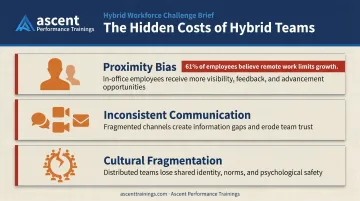
- Proximity bias: Managers unconsciously favor in-office employees when it comes to feedback, visibility, and advancement. SHRM research found that more than 4 in 10 executives rank inequities between remote and in-office workers as their top concern — and 61% of employees believe remote work limits their professional growth.
- Inconsistent communication: Email, chat, video, and in-person conversation carry different emotional signals and trust levels. Leaders who default to one channel disadvantage people on others.
- Cultural fragmentation: Team cohesion erodes when shared rituals, visibility, and informal interactions aren't deliberately rebuilt across both environments.
These problems don't resolve themselves — they require a different kind of leadership capability to address.
The Skills That Actually Matter
Traditional training programs focus on presence-based leadership: read the room, motivate in real time, manage by observation. Hybrid leadership requires a different set:
- Results-based performance management — evaluating output and contribution, not hours logged or desk presence
- Inclusive meeting design — structuring discussions where remote participants aren't second-class attendees
- Psychological safety across both groups — building trust without consistent physical interaction
- Digital communication fluency — choosing the right channel for the right conversation
Harvard Business Publishing found that fewer than 3 in 10 hybrid employees said their manager did very well at supporting relationship-building and connection. The tools aren't the issue — most teams already have video conferencing and messaging platforms. What's missing is the training to use those environments effectively as a leader.
Best Leadership Training Programs for Hybrid Teams
The programs below were selected based on delivery flexibility, whether the curriculum addresses hybrid-specific challenges, facilitator quality, post-training support, and real-world applicability.
Ascent Performance Trainings
Founded by Tim Carlisle — a globally recognized authority with over 30 years of training experience delivered across 75+ countries — Ascent Performance Trainings offers a multi-modal leadership development model built for complex, modern work environments, including hybrid teams in technology, financial services, and oil and gas.
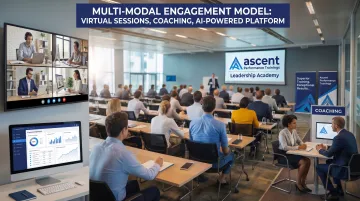
What sets Ascent apart is the architecture of the engagement. The model integrates multiple learning modes and sustains development long after the final session:
- In-person workshops, live virtual sessions, and one-on-one coaching
- A 24/7 AI-powered self-paced platform for on-demand reinforcement
- 8 weeks of post-training follow-through (weekly videos and monthly coaching calls)
The Ascent Leadership Academy runs as a structured 10-week program built around the PERFORM Leadership methodology, developing emotional intelligence, decision-making, strategic thinking, and team leadership.
Participants complete the program with a Proprietary Ascent Performance Training Certificate.
| Attribute | Details |
|---|---|
| Training Format | In-person, virtual instructor-led, one-on-one coaching, self-paced — available across 75+ countries |
| Key Features | PERFORM Leadership methodology, AI-powered adaptive learning, 8-week post-training reinforcement, Proprietary Certificate |
| Best For | Organizations in technology, financial services, and oil and gas seeking measurable performance outcomes for hybrid teams |
Center for Creative Leadership (CCL)
Founded in 1970, CCL has over 50 years of leadership research behind its programs and counts more than two-thirds of the Fortune 1000 among its clients. It offers programs for every leadership level, from frontline managers to the C-suite.
CCL's strengths are its rigorous research base and its feedback-heavy, immersive format. Programs that emphasize 360-degree assessments and behavioral change are well-suited to hybrid leadership, where self-awareness about bias and communication style affects team equity.
| Attribute | Details |
|---|---|
| Training Format | In-person and virtual; structured cohort-based learning |
| Key Features | Research-based content, validated 360-degree feedback assessments, high facilitator-to-participant ratios |
| Best For | Mid to senior leaders seeking deep personal development and evidence-based skill building |
Dale Carnegie Training
Dale Carnegie has been developing leaders since 1912, operating across 80+ countries in 30+ languages with 2,800+ certified trainers. It holds ISO 9001:2015 certification, and the American Council on Education recommends college credit for its Leadership Training for Managers course.
Its focus on confidence, trust-building, and people skills translates well to hybrid environments, where leaders must motivate employees they rarely see in person and build cohesion across physical and digital channels.
| Attribute | Details |
|---|---|
| Training Format | In-person and virtual instructor-led; available globally through licensed training centers |
| Key Features | The Dale Carnegie Method, certified trainer network, practical application focus, delivery in 30+ languages |
| Best For | Organizations needing globally consistent delivery with a confidence-building and communication-focused curriculum |
Coursera (Hybrid Work & Leadership Programs)
Coursera's platform includes Managing Hybrid Teams (offered by Packt, updated May 2025) and The Future of Work — Managing Hybrid & AI-Augmented Teams (Board Infinity), both available through Coursera Plus at $399/year. These are 100% online and self-paced.
The content covers results-based accountability, fostering collaboration between in-office and remote employees, and navigating split-team dynamics. It's the most accessible and scalable option here — well-suited to large organizations or individual learners working within tight budgets.
| Attribute | Details |
|---|---|
| Training Format | 100% online, self-paced; available through Coursera Plus |
| Key Features | Hybrid-specific leadership curriculum, flexible scheduling, Coursera Plus subscription access |
| Best For | Budget-conscious organizations or individual leaders seeking scalable, on-demand hybrid leadership development |
Note: Coursera pricing changes frequently — verify current pricing before purchase.
Powers Resource Center
Powers Resource Center specializes exclusively in leading distributed and hybrid teams — a narrow focus that shapes every element of its curriculum. CEO Tara Powers is the author of Virtual Teams for Dummies and Working from Home for Dummies, and the organization has earned Brandon Hall leadership development awards in both 2024 and 2025.
PRC's Leadership Accelerator programs run 4–5 months and are available on-site, virtually, or through self-directed eLearning. The provider reports a 42% increase in confidence and skill level across 35,000+ leaders trained — results that reflect the depth of their hybrid-specific focus.
| Attribute | Details |
|---|---|
| Training Format | On-site, virtual instructor-led, and eLearning; global availability |
| Key Features | Hybrid/virtual team-specific curriculum, group coaching, personal measurement tools, Brandon Hall award recognition |
| Best For | Leaders specifically seeking training built around the mechanics of virtual and hybrid team management |
Key Features to Look for in a Hybrid Leadership Training Program
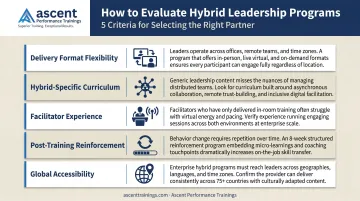
Not all leadership programs are created equal, and brand recognition is a poor proxy for fit. When evaluating options for hybrid teams specifically, three criteria separate programs that actually work from ones that just look good on paper:
Delivery Flexibility
The program must work for leaders regardless of their location. If it's only available in one format — say, in-person only or self-paced only — it excludes part of the workforce it's meant to serve. Look for programs that blend virtual, in-person, and asynchronous options.
Hybrid-Specific Content
This is the most common gap. Many programs teach general leadership principles without addressing proximity bias, equitable meeting design, or trust-building across distance. Ask providers directly: does your curriculum directly address hybrid work challenges? A vague answer means the content isn't there.
Post-Training Reinforcement
Skills fade quickly without reinforcement. Programs that end on the final workshop day leave most of the behavior-change value on the table. Prioritize programs that include:
- Follow-up coaching sessions
- Structured application exercises
- Behavioral tracking or assessments
- Manager accountability tools
Ascent Performance Trainings, for example, builds an 8-week post-training reinforcement program into every engagement — weekly video content plus monthly coaching sessions designed to convert classroom learning into on-the-job behavior change. That kind of structured follow-through is what distinguishes a capability-building program from a one-day workshop.
Used together, these three criteria give you a reliable filter for separating programs designed for hybrid realities from those retrofitted to fit them.
How to Choose the Right Program
Evaluation Criteria That Matter
Not all programs are built equally — or for the same audience. Use these criteria to filter options before committing.
| Criteria | Why It Matters |
|---|---|
| Delivery format flexibility | Ensures all leaders can participate regardless of location |
| Hybrid-specific curriculum | Addresses actual hybrid challenges, not just general leadership theory |
| Facilitator experience | Depth of expertise translates to more applicable content |
| Post-training reinforcement | Determines whether skills transfer back to the workplace |
| Global accessibility | Critical for geographically distributed leadership teams |
Common Selection Mistakes
Even well-resourced organizations end up with the wrong program. These are the most common missteps:
- Selecting by brand alone — A well-known program built for in-person executives won't solve hybrid leadership gaps. Fit matters more than reputation.
- Ignoring reinforcement — Skills built in a single workshop erode within weeks. Without structured follow-through, the training becomes a one-time event, not a behavior shift.
- Skipping a needs assessment — If a provider offers a one-size-fits-all solution without any diagnostic step, that's a red flag. Strong programs scope the gaps first, then design the curriculum.
Conclusion
Hybrid work is now a permanent feature of how most organizations operate — and hybrid leadership is a permanent competency requirement to match. Organizations that treat it as a transitional phase are already behind.
The leaders who perform well in this environment aren't necessarily the most experienced. They're the ones who've learned to manage outcomes rather than presence, and to build trust without relying on physical proximity. That skill set doesn't develop through exposure alone. It requires deliberate, structured training with real reinforcement behind it.
Once you've accepted that training is necessary, the next question is which program will actually deliver. Look past cost and prestige. Ask whether the curriculum addresses the specific dynamics of hybrid work, whether delivery formats match your team's geography, and whether the program includes a reinforcement structure that extends learning beyond the workshop itself.
Organizations ready to invest in leadership training with measurable outcomes can explore Ascent Performance Trainings' programs — delivered across 75+ countries through in-person, virtual, and on-demand formats, with an 8-week post-training reinforcement structure built to embed behavior change across hybrid and distributed teams.
Frequently Asked Questions
What is the 70-20-10 rule in leadership?
Developed at CCL in the 1980s, the 70-20-10 model holds that leaders build 70% of skills through on-the-job experience, 20% through coaching and peer learning, and 10% through formal training. In hybrid programs, this means pairing formal modules with live application and manager coaching — not running them as standalone events.
What are the 5 C's of leadership?
The 5 C's — Competence, Courage, Communication, Character, and Commitment — are core leadership qualities that apply in any environment. In hybrid settings, leaders must demonstrate each across both physical and digital channels, since in-person presence is no longer a reliable substitute.
What is the best leadership style for hybrid teams?
Transformational and situational leadership styles tend to perform best in hybrid environments. Transformational leaders prioritize trust, autonomy, and motivation — qualities that compensate for reduced visibility over remote workers. MIT Sloan also recommends a multimodal approach: virtual coordination for routine work, face-to-face interaction for innovation and conflict resolution.
What skills should a hybrid team leader develop first?
Focus first on results-based performance management, inclusive digital communication, and trust-building without physical proximity. These three areas address the most common hybrid management failures and build the groundwork for equitable treatment, team cohesion, and consistent performance across locations.
How do you measure the ROI of leadership training for hybrid teams?
Use Kirkpatrick's four levels (Reaction, Learning, Behavior, Results) alongside Phillips' ROI methodology to connect training outcomes to financial terms. Track manager behavior change, retention, engagement scores, and equitable promotion rates — and define those metrics before the program starts, not after.
How long does leadership training for hybrid teams typically take?
Duration matters less than follow-through. Programs range from a few hours (self-paced courses) to several months (such as Ascent's 10-week Leadership Academy), but the most effective ones pair an intensive learning phase with structured reinforcement to ensure skills transfer to the job.