

But treating them as interchangeable creates real damage: misaligned KPIs, frustrated leaders, and teams that burn out chasing the wrong targets. According to Gartner, only 18% of sales managers lead high-performing teams — and unclear role expectations are a primary driver of that gap.
This article breaks down what each role actually does, where they differ, and how the two functions should work together to drive sustainable growth.
TL;DR
- A Business Development Manager (BDM) builds future revenue — through new markets, strategic partnerships, and long-term opportunity creation.
- Sales Managers drive current revenue — leading the team, managing the pipeline, and closing deals on existing products or services.
- Their core difference is time horizon: BDMs think in months to years; Sales Managers think in weeks to quarters.
- They're measured on entirely different metrics — and applying the same KPIs to both roles is a costly mistake.
- Companies need both: BD identifies where the opportunity is, Sales converts it into revenue.
BDM vs. Sales Manager: Quick Comparison
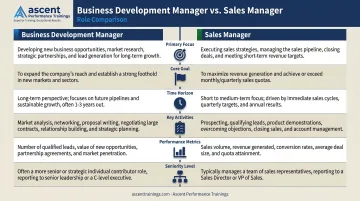
Both roles drive revenue — but from opposite directions. The table below breaks down where they diverge across six key dimensions.
| Dimension | Business Development Manager | Sales Manager |
|---|---|---|
| Primary Focus | Market expansion, strategic partnerships, new revenue channels | Revenue generation, pipeline management, team performance |
| Core Goal | Create future opportunities and long-term growth | Convert existing opportunities into closed deals |
| Time Horizon | Long-term (6 months to multiple years) | Short-to-medium-term (weekly, monthly, quarterly) |
| Key Activities | Market research, partnership development, new channel creation | Coaching reps, tracking quotas, managing pipeline stages |
| Performance Metrics | New markets entered, partnerships formed, pipeline growth | Revenue closed, quota attainment, conversion rate, deal volume |
| Seniority Level | Senior-level strategic and growth-focused scope | Mid-level execution and operational management |
What Is a Business Development Manager?
A BDM is a strategic growth driver whose job is to identify where the business could go, then build the relationships and infrastructure to get there. They rarely carry a monthly quota. Their impact often takes a year or more to materialize — by design.
Core Responsibilities
Day-to-day, a BDM is focused on:
- Researching new markets and evaluating competitive whitespace
- Identifying and qualifying new business opportunities before handing them off to sales
- Building and nurturing high-level partnerships with potential clients, channel partners, and strategic allies
- Developing long-term growth plans in coordination with leadership, marketing, and product teams
- Representing the company in conversations that require executive-level credibility
Skills That Define an Effective BDM
BDM effectiveness depends on a distinct skill set that goes well beyond typical sales experience:
- Connects market dynamics to long-term company positioning through strategic thinking
- Structures complex partnership agreements, not just transactional closes
- Spots market opportunities before they become obvious to competitors
- Builds trust with C-suite and senior external stakeholders over extended timeframes
- Aligns sales, marketing, product, and finance teams around new opportunities
How BDM Success Is Measured
BDM metrics reflect long-term output rather than monthly quotas:
- New markets entered
- Strategic partnerships established
- Pipeline growth from new channels
- Market share expansion over multi-year cycles
Where BDMs Deliver the Most Value
The BDM role is especially critical in:
- Companies scaling into new geographies or verticals
- Organizations launching new product lines that require market education before selling
- B2B businesses building referral or channel partner networks
- Industries like technology, financial services, and enterprise B2B — where relationship cycles are long and trust must be established long before any transaction occurs
What Is a Sales Manager?
A Sales Manager is the operational leader of the revenue team. Their job is to take qualified opportunities and convert them into closed revenue — consistently, predictably, and at scale. Where a BDM builds the pipeline landscape, the Sales Manager executes within it.
Core Responsibilities
A Sales Manager's week looks like:
- Coaching and managing individual sales representatives
- Setting and tracking individual and team quotas
- Overseeing pipeline health and deal progression through each funnel stage
- Running performance reviews and one-on-ones
- Coordinating with marketing on lead quality and campaign alignment
- Handling escalations and complex deal support for their team
Skills That Define a Strong Sales Manager
Strong Sales Managers combine operational discipline with people leadership:
- Coaching and mentoring — developing reps through consistent feedback, not just monitoring numbers
- Pipeline management — identifying where deals stall and intervening before opportunities die
- Data-driven decision-making — using CRM data to allocate time and resources effectively
- Objection handling — knowing when and how to step into deals
- Performance leadership — motivating a team to sustain effort through pressure and slow periods
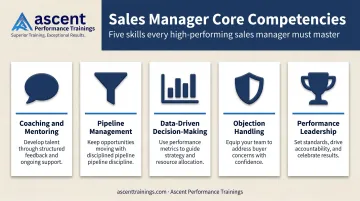
These capabilities require targeted development investment, distinct from field-level sales skills.
How Sales Manager Success Is Measured
Sales Managers are accountable to near-term, quantifiable results:
- Revenue closed per period
- Team quota attainment rate
- Conversion rates at each funnel stage
- Average deal size
- Ramp time for newly hired reps
Where Sales Managers Are Essential
Sales Managers become critical infrastructure for any organization with:
- Two or more sales reps who need direction and accountability
- A defined product or service with an established sales motion
- Consistent pipeline that needs structured conversion management
- A leadership team focused on maximizing revenue from existing market position
In industries like technology, financial services, and oil and gas, Sales Managers are often where growth strategy meets actual revenue execution — which is precisely why Sales Management development tends to be among the first training investments organizations make. Ascent Performance Trainings' Sales Leadership Development programs are built to address that gap directly, bridging field-level sales skill and the management capability teams need to perform at scale.
Key Differences: Business Development vs. Sales Management
Time Horizon and Goal Structure
BDMs build what Sales Managers then run. One role designs the growth strategy; the other executes it daily. Both are essential, but they operate on completely different clocks.
Sales Managers live in weekly and quarterly cycles — near-term, highly visible accountability. BDMs work on 6-month to multi-year timelines where results take time to materialize.
This is why they should never share the same KPIs. Assigning a BDM a 90-day revenue quota is a structural error — it forces a long-cycle role into a short-cycle evaluation framework and sets the role up to fail by design. If you need revenue now, develop your Sales Manager. If you're building tomorrow's pipeline, invest in your BDM.
Stakeholder Interaction
The two roles operate in fundamentally different relationship environments:
- Sales Managers interact daily with their team and existing customers — transactional, process-driven, focused on moving deals forward
- BDMs engage with senior external partners, executive contacts, and cross-functional internal teams — relational, strategic, focused on building the conditions for future deals
Skill Profiles and Training Needs
| Competency Area | BDM | Sales Manager |
|---|---|---|
| Strategic thinking | ✅ Core | Secondary |
| Market analysis | ✅ Core | Minimal |
| Partnership negotiation | ✅ Core | Limited |
| Coaching and mentoring | Secondary | ✅ Core |
| CRM and pipeline management | Supporting | ✅ Core |
| Quota accountability | Not applicable | ✅ Core |
Each role demands a distinct development track. BDMs need training in market analysis, executive communication, and long-horizon deal-making. Sales Managers need coaching frameworks, pipeline discipline, and performance management skills.
The Seniority Question
BDMs are often perceived as more senior due to their strategic scope. But hierarchy varies significantly by company. In some organizations, the Sales Manager carries greater team authority. In others, the BDM reports to the VP of Sales alongside the Sales Manager at the same level. What matters more than org chart position is function and time horizon.
How BDMs and Sales Managers Work Together
When these roles are clearly defined and deliberately connected, both perform significantly better.
The Handoff Model
BDMs identify and qualify strategic opportunities — new markets, new channels, new partnership structures. Once those opportunities are mature enough to act on, they hand off well-qualified leads and partnerships to the Sales Manager and their team for conversion. That transition, when structured and intentional, is where pipeline quality directly drives revenue outcomes.
Gartner research shows that organizations prioritizing sales pipeline quality are 2x more likely to exceed customer acquisition expectations. That quality starts upstream — with BD.
What Strong Collaboration Looks Like
In practice, aligned BD and Sales functions share:
- Regular joint planning sessions with clear agenda ownership
- Shared pipeline visibility so Sales knows what BD is cultivating
- Defined handoff criteria — what qualifies an opportunity for Sales to take over
- Consistent messaging across both teams so client experience is seamless
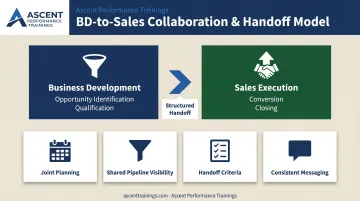
Forrester reports that companies with high alignment across customer-facing functions achieve 2.4x higher revenue growth than those without it. BD-to-Sales alignment is a direct contributor to that outcome.
Investing in Both Functions
Organizations that invest in development for both roles — individual skills and cross-functional alignment — see faster ramp times, stronger conversion rates, and more sustainable growth. Ascent Performance Trainings' Sales Leadership Development programs focus specifically on building the management capability that makes BD-to-Sales collaboration work: structured handoff processes, shared accountability, and the leadership skills Sales Managers need to convert what BD brings in.
Conclusion
Business Development and Sales Management aren't competing functions. They're complementary disciplines that operate on different timelines with different success measures. Most organizations don't need to choose between them — they need to define each one clearly enough that both can actually do their jobs.
Companies that draw that distinction, invest in the right training for each function, and build structured collaboration between them consistently outperform those that blur the lines. Start by auditing how each role is currently defined in your organization — then close the gaps.
Frequently Asked Questions
Is a Business Development Manager (BDM) higher in rank than a Sales Manager?
Hierarchy varies by organization. BDMs often carry a broader strategic scope, but Sales Managers may have greater team authority and operational accountability. The more useful distinction is function and time horizon, not org chart position alone.
Which is better: Business Development Manager (BDM) or Business Development Executive (BDE)?
Neither is "better" — they operate at different levels. A BDE is typically an entry-to-mid-level individual contributor focused on outreach and lead generation, while a BDM is a manager-level role with strategic and leadership responsibilities with a longer planning horizon.
Can the same person be both a Business Development Manager and a Sales Manager?
In early-stage or smaller companies, one person often covers both functions out of necessity. As an organization scales, separating the roles allows each to operate more effectively within their own skill sets, time horizons, and accountability structures.
What are the key performance metrics for a BDM vs. a Sales Manager?
BDMs are measured on new markets entered, partnerships established, and long-term pipeline growth. Sales Managers are tracked on revenue closed, quota attainment, conversion rates, and team performance. Applying the same metrics to both roles leads to misaligned expectations and muddled accountability.
Do Business Development Managers and Sales Managers need different training?
Yes. BDMs require development in strategic thinking, market analysis, and high-level negotiation. Sales Managers need coaching proficiency, pipeline management, and performance leadership skills.
What is the difference between a BDM and a BDR (Business Development Representative)?
A BDR is an entry-level role focused on prospecting, cold outreach, and qualifying leads at the top of the funnel. A BDM is a senior role responsible for strategy, partnerships, and team leadership. BDRs typically report to or are developed by BDMs as they advance in their careers.