Introduction
Most new sales managers get promoted because they were exceptional at selling — not because anyone trained them to lead. That's a meaningful distinction, and the gap between the two creates real problems.
Research from ATD found that approximately 40% of sales leaders did not receive adequate training before assuming leadership roles. HBR has pointed out that when first-line sales management breaks down, the entire sales force suffers — yet most organizations invest far more in developing individual reps than in the managers responsible for coaching them.
This guide covers what sales management training actually is and why the mindset shift from top rep to manager is harder than it looks. It also walks through the core skills every structured program must develop, what to look for when choosing one, and a practical 90-day framework for new managers stepping into the role.
TLDR
- 40% of sales leaders lacked adequate training before stepping into management
- Being a top rep does not make someone a top manager — the skills are fundamentally different
- Structured coaching correlates with 19% higher win rates and 21% higher quota attainment
- New managers need five core skills: leadership, coaching, communication, pipeline management, and conflict resolution — each distinct from selling
- The first 90 days should follow a listen → assess → lead progression
What Is Sales Management Training (and Why New Managers Need It Most)
Sales management training is a structured learning process designed to equip individuals with the skills to lead, coach, develop, and hold a team of sales professionals accountable. The definition draws a sharp line between two things that often get conflated.
Sales training builds an individual's ability to prospect, present, and close. Sales management training builds a leader's ability to help others do those things consistently — a completely different skill set that requires deliberate, separate development.
The gap between investment in each is striking. CSO Insights reported that 18.6% of organizations provided no training for sales managers, compared to just 5.5% providing no training for salespeople. Rep development gets prioritized; manager development often gets assumed.
The Sales Management Association's competency framework separates sales competencies from sales management competencies entirely. Manager-specific capabilities — ones that don't automatically transfer from being a high-performing rep — include:
- Coaching individual reps toward consistent performance
- Managing performance through structured accountability
- Developing sales talent at scale within the team
The purpose of sales management training is to build these capabilities deliberately — because leading a team requires a skill set that selling never taught.
The Critical Mindset Shift: From Top Rep to Sales Manager
The Individual Contributor to Multiplier Transformation
As a rep, your results are personal. You own your pipeline, your relationships, your close rate. Promotion changes the equation completely: your results now live entirely inside your team's numbers.
That shift is psychologically harder than most organizations acknowledge. The instincts that made someone a great rep — personal ownership and a bias for doing — can actively undermine their effectiveness as a manager.
A rep who closes deals through persistence may become a manager who jumps into deals instead of coaching reps through them. One who thrived on individual activity volume may measure their worth by how busy they personally are, rather than by team output.
Research from the Chicago Booth Review, drawing on data from 48,000 sales associates and 5,000 managers across 200+ companies, found that managers whose own sales had doubled before promotion were associated with a 10% drop in new subordinates' sales performance. Elite individual contributors don't automatically become effective people leaders — and the data backs that up.
That gap between rep performance and manager effectiveness shows up consistently in the same failure patterns.
Common Failure Patterns in Untrained New Managers
New managers who haven't made this mental shift tend to fall into predictable traps:
- Deal rescuing — taking over a rep's opportunity instead of coaching the rep to handle it
- Activity myopia — focusing on their own output volume rather than team-level metrics
- Micromanagement — maintaining direct control because relinquishing it feels uncomfortable
- Results-only feedback — discussing pipeline status rather than the specific behaviors that need to change (HBR identifies this as one of the most common coaching failures)
Structured training addresses this directly. When new managers practice active coaching, delegation, and structured accountability before full performance pressure hits, the transition produces better outcomes — for the manager and the team.
Core Skills Every New Sales Manager Must Develop
Effective sales management training builds five interconnected capabilities — and gaps in any one of them limit the other four.
Leadership and Vision-Setting
New managers must move from executing someone else's strategy to setting direction for their team. That means translating company revenue targets into specific team goals, communicating clear priorities consistently, and modeling the accountability standards they expect from their reps.
Leadership isn't a personality trait. It's a learnable system — and programs that treat it that way produce better outcomes than those built around inspiration alone.
Coaching vs. Managing
There's a real difference between managing activities and coaching performance:
| Managing | Coaching |
|---|---|
| Tracking call volume | Identifying skill gaps |
| Checking CRM entries | Running structured 1:1s |
| Monitoring task completion | Delivering behavior-specific feedback |
| Reporting on results | Diagnosing why results are happening |
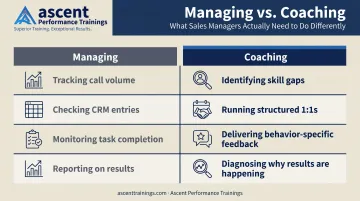
CSO Insights found that 62.9% of organizations relied on random or informal coaching, while dynamic, structured coaching correlated with 19% higher win rates and 21.3% higher quota attainment. The difference between a good and great sales manager often comes down to whether they coach with intention or manage by exception.
Communication Cadence and Consistency
Structured coaching only works if reps understand what they're being coached toward. That's why communication cadence matters as much as coaching skill.
Great sales managers repeat the same priorities across team meetings, one-on-ones, and written updates. Reps need to hear a priority multiple times — and in multiple contexts — before it actually shifts how they work day-to-day.
Pipeline and Forecast Management
As reps, most new managers operated on instinct — they knew their deals. As managers, they need data literacy:
- Understanding stage-level conversion rates
- Identifying stalled or at-risk opportunities early
- Assessing forecast accuracy by rep
- Using metrics to prioritize coaching, not to replace it
Without this skill, managers default to chasing activity numbers instead of spotting the pipeline risks that actually threaten the quarter.
Conflict Resolution and Culture-Building
Managers must handle performance gaps and interpersonal friction in ways that preserve both trust and accountability — which is harder than either alone. In practice, that means addressing a missed quota directly while still supporting the rep's development — not letting it slide, and not making it a public correction. Building a results-oriented culture requires both high standards and the psychological safety that makes honest conversations possible.
What an Effective Sales Management Training Program Covers
Not all programs are built for the same audience. Here's what to look for when evaluating options for new managers specifically.
Leadership Development Modules
Look for programs that teach leadership as a learnable system — vision articulation, motivating different personality types, strategic thinking under pressure. Self-awareness tools like DISC or EQ assessments are particularly valuable for new managers navigating the shift from individual contributor to people leader.
Coaching Frameworks with Practical Application
Theory without practice doesn't change behavior. High-quality programs include:
- Role-play scenarios built around real sales situations
- Call review and deal coaching simulations
- Structured feedback exercises with observable behavioral benchmarks
Ascent Performance Trainings incorporates role-play-based sessions with real-world scenarios as a core delivery method, facilitated by experienced practitioners with direct sales leadership backgrounds.
Post-Training Reinforcement
Behavior change requires repetition over time — knowledge that isn't reinforced fades quickly. Programs that end at the workshop rarely produce lasting results.
Ascent Performance Trainings addresses this with 8 weeks of post-program support: weekly reinforcement videos delivered via email to anchor key concepts, plus monthly one-on-one coaching sessions where participants work through individual challenges, set specific goals, and receive tailored feedback.
As one Chief Revenue Officer who went through the program put it: "Most programs leave you after the workshop, but Ascent Performance ensured our team had the reinforcement and coaching needed to sustain long-term success."
Certification and Measurable Completion Standards
Programs that culminate in a formal certification — like the Proprietary Ascent Performance Training Certificate — create a tangible accountability structure. Certification gives organizations a verifiable benchmark for manager readiness while giving participants a defined endpoint to work toward.
Your First 90 Days as a New Sales Manager: A Practical Framework
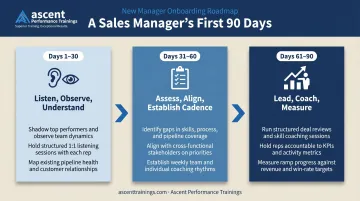
The 30-60-90 day framework is a phased approach to building credibility, diagnosing the team's reality, and leading with intention — rather than overhauling everything on day one or reverting to the instincts of a top-performing rep.
Days 1–30: Listen, Observe, and Understand
The first month is for diagnosis, not intervention. Specifically:
- Meet individually with each rep to understand their strengths, motivations, and challenges
- Review existing pipeline health without judgment
- Learn how the sales process is actually practiced, not just how it's documented
- Resist the urge to fix anything before you understand what's actually broken
By day 30, your goal is a clear picture of the team's actual state — strengths, gaps, and where your attention will matter most going forward.
Days 31–60: Assess, Align, and Establish Cadence
Once you understand the team's reality, begin structuring how you'll operate:
- Identify the 1–2 highest-leverage coaching opportunities for the team
- Align individual rep targets to broader organizational goals
- Establish your operational rhythm: weekly 1:1s, pipeline reviews, and team meetings with a consistent, structured format
Reps need to know when and how they'll connect with you. A predictable cadence builds trust more reliably than sporadic, high-intensity check-ins.
Days 61–90: Lead, Coach, and Measure
By day 60, active coaching with a structured methodology is your default mode:
- Hold the team accountable to agreed standards — with specificity, not generalities
- Track leading indicators: activity levels, pipeline coverage, stage conversion rates
- Adjust your coaching focus based on what the data reveals, not what feels urgent
- Move from understanding the team to actively developing it
This is where the mindset shift from rep to manager becomes visible — not in what you say, but in how you spend your time each day.
How to Choose the Right Sales Management Training Program
Evaluation Criteria
When assessing programs, ask:
- Does the curriculum specifically address the rep-to-manager transition, or is it designed for experienced leaders?
- Does it balance hard skills (pipeline management, KPIs) with soft skills (coaching, communication, conflict resolution)?
- Is delivery flexible — in-person, virtual, or blended — to match how your organization actually operates?
- Does it include post-training reinforcement, or does support end when the workshop does?
Red Flags to Watch For
- Heavy on theory, light on structured practice or role-play
- No post-training reinforcement plan
- No measurable competency standards or defined outcomes behind the certification
- Certification with no defined competency standards behind it
Ascent Performance Trainings
One program that checks all of these boxes is worth calling out directly. Ascent Performance Trainings — founded by Tim Carlisle, with over 30 years of sales leadership expertise and programs delivered across 75+ countries — offers a structured 10-week Leadership Academy covering emotional intelligence, decision-making, coaching, and strategic thinking.
Unlike single-event training, the program includes a post-program infrastructure: 8 weeks of reinforcement plus monthly coaching sessions designed to embed new behaviors over time. Delivery spans in-person, live virtual, and on-demand formats, closing with a proprietary certification.
Frequently Asked Questions
Frequently Asked Questions
What type of training is required for a sales manager?
Effective sales management training covers leadership, communication, coaching methodologies, pipeline management, and accountability frameworks. The strongest programs address both data management and people management — because each demands a different capability set.
What is the 30-60-90 rule in sales?
The 30-60-90 framework structures a new manager's first quarter into three phases: days 1–30 for learning and listening, days 31–60 for assessing and aligning, and days 61–90 for actively leading and executing. It prevents the common mistake of making sweeping changes before fully understanding the team.
What is the 10-3-1 rule in sales?
The 10-3-1 rule is a prospecting ratio: for every 10 prospects contacted, approximately 3 will engage seriously, and 1 will convert. New managers use it to set realistic activity expectations and build pipeline coverage targets for their teams.
What are the 5 C's of sales?
The 5 C's — commonly defined as Contact, Connect, Communicate, Close, and Continue — give managers and reps a shared language for the sales process. When everyone uses the same framework, coaching becomes stage-specific rather than generic — which makes feedback far more actionable.
What is the difference between sales training and sales management training?
Sales training builds an individual's ability to prospect, present, and close. Sales management training builds a leader's ability to coach others to do those things at scale. Treating them as interchangeable is one of the most common reasons strong reps struggle after promotion.
How long does it typically take to become an effective sales manager?
Most new managers need 6–12 months to develop core management competencies, though the timeline varies by individual and organizational context. Structured training with ongoing reinforcement — rather than a single training event — can compress that ramp time.