
According to ATD's 2023 State of Sales Training report citing Gartner research, B2B sales reps forget 70% of training information within one week and 87% within a month. The workshop ends, the energy fades, and without a structured follow-up system, so does the skill.
This article covers why training fails at the reinforcement stage, what the consequences look like in real revenue metrics, and what high-performing organizations actually do to make skills stick.
TL;DR
- Sales training without reinforcement produces rapid skill decay — research shows up to 90% of new skills fade within a week without active revisiting
- One-off event formats, absent manager follow-through, no practice structure, and zero accountability are the primary failure drivers
- Skipping reinforcement costs organizations in lost ROI, missed quotas, rep disengagement, and turnover
- Effective reinforcement uses spaced repetition, coaching, role-play, and microlearning sustained across weeks — not compressed into a single event
- For training to stick, reinforcement must be built into how the sales function operates day to day
Why Sales Training Fails Without Reinforcement
Sales training failure is rarely about the content, the facilitator, or the program design. It's about what doesn't happen after the event ends.
The Forgetting Curve Works Against You
Hermann Ebbinghaus's foundational memory research — replicated and analyzed by Murre and Dros in 2015 — showed that memory savings dropped to roughly 33.7% after one day and 25.4% after six days without review. That's under controlled laboratory conditions. In sales, the decay risk compounds further: reps must retrieve and apply complex frameworks live, mid-conversation, with no pause to review notes.
When a prospect raises an unexpected objection, there's no opportunity to look anything up. Knowledge that isn't reinforced isn't available when it's needed most.
Event-Based Training Creates False Confidence
A two-day workshop generates real enthusiasm. Reps leave energized, notebooks full, intentions high. Then Monday arrives.
That enthusiasm hits the reality of a full pipeline, back-to-back calls, and zero structured follow-through. Without continued exposure and deliberate practice, skills feel learned but aren't operational. Lally et al.'s research on habit formation found that automaticity (the point where a behavior becomes natural and effortless) takes anywhere from 18 to 254 days, with an average of 66 days. A single training event gets a rep nowhere near that threshold.
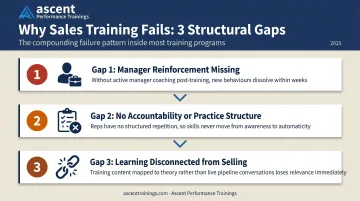
Three Structural Gaps That Accelerate Failure
Managers lack a reinforcement framework. When sales managers haven't internalized the training, they can't model it, coach to it, or hold reps accountable for using it. Even excellent training stalls at the manager layer.
No accountability or practice structure exists post-event. Without defined action plans, follow-up check-ins, or spaced practice sessions, reps revert to old habits. The path of least resistance always wins when new behaviors aren't held to any standard.
Learning formats are disconnected from actual selling. A standalone workshop or static LMS module that isn't integrated with real deal coaching, CRM workflows, or live selling activity creates a knowledge-to-action gap. Reps can recite the framework — they just can't use it fluently under pressure.
What Happens When You Skip Sales Training Reinforcement
Ignoring post-training reinforcement doesn't just waste budget — it actively degrades performance, morale, and organizational results.
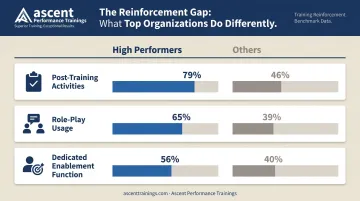
The performance gap between organizations that reinforce and those that don't is measurable. ATD found that 79% of high-performing organizations used post-training activities, compared to just 46% of others. CSO Insights data tells a similar story: dynamic coaching processes improved win rates by 27.9% and quota attainment by 10.2%.
Meanwhile, Salesforce's State of Sales report found that 67% of sales reps didn't expect to meet quota in 2024, and 84% missed quota the prior year. Underperformance at that scale isn't a hiring problem — it's a development and reinforcement problem.
The breakdown follows a predictable sequence:
- Skills fade → reps struggle to execute trained techniques
- Struggle → confidence drops, frustration rises
- Low confidence → disengagement increases
- Disengagement → turnover rises
- Turnover → training investment must restart from zero
Every stage of that spiral carries a price tag:
- Training spend goes unrecovered when reps never reach proficiency
- Onboarding timelines stretch as skills fail to develop on pace
- Re-training or replacing underperforming reps layers new costs onto the original investment
Warning Signs Your Sales Training Is Already Failing
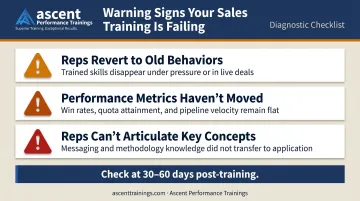
Run this checklist 30–60 days after any training program:
- Reps revert to old behaviors — pre-training habits return because nothing reinforced the new ones
- Performance metrics haven't moved : close rates, deal sizes, and pipeline activity remain flat or decline in the 60–90 days post-training
- Reps can't articulate key concepts — ask a rep to walk through a trained framework and they draw a blank, a reliable indicator that spaced repetition never happened
Best Practices for Sales Training Reinforcement
Reinforcement isn't a single tactic — it's a system applied consistently over time. The goal is simple: move skills from the training room into daily sales behavior, where they stick.
Spaced Repetition and Microlearning
Break post-training content into short, focused touchpoints — ideally 5–10 minutes — delivered at regular intervals rather than in a single follow-up session. ATD identifies 2–10 minutes as the most effective microlearning segment length for workplace training.
Each revisit before the skill fades reinforces the neural pathway, making long-term retention more likely. Research supports expanding intervals over time: revisit sooner early on, then stretch the gaps as retention strengthens.
Start within 24–48 hours of initial training and continue on a structured schedule for a minimum of 8 weeks. Waiting until "a few weeks later" for a single follow-up misses the window when decay is fastest.
Structured Coaching and Accountability Check-ins
Implement recurring 1:1 coaching sessions focused on skill application — reviewing real calls, live deals, and client interactions through the lens of trained behaviors, not just pipeline numbers.
Coaching converts abstract training concepts into personalized, contextual feedback that reps can immediately apply. It also signals organizational commitment to the training, which directly increases rep buy-in. CSO Insights found dynamic coaching processes were the clearest manager-level reinforcement lever linked to quota improvement. Establish a consistent weekly or bi-weekly cadence starting immediately post-training.
Ascent Performance Trainings builds this directly into its programs through a structured 8-week post-training reinforcement system — weekly emails with video touchpoints and application reminders, plus monthly 1:1 coaching sessions where reps work through individual challenges and receive tailored feedback.
"Exceptional performance is learned, refined, and sustained." — Tim Carlisle, Founder, Ascent Performance Trainings
Role-Play and Real-World Practice Scenarios
Create regular, structured role-play exercises built around actual objections, buyer types, and deal scenarios — not generic scripts.
Active practice in a low-stakes environment forces reps to recall and apply trained techniques under simulated pressure. ATD found that 65% of high-performing organizations used non-technology simulations such as in-person role plays, compared to just 39% of other organizations — a gap that reflects how seriously top teams treat deliberate practice.

Incorporate role-play into recurring team meetings and coaching sessions. Rotate scenarios to match current pipeline challenges rather than running the same exercise on a loop.
Technology-Embedded Reinforcement
Integrate training concepts and job aids directly into the tools reps use daily — CRM platforms, communication tools, or a dedicated learning platform with content recommendations tied to individual skill gaps.
Embedding reinforcement in workflow eliminates the friction between knowing and doing. Reps get prompted to apply the right skill at the right moment rather than trying to recall it from a workshop three weeks ago.
Ascent's 24/7 online learning platform delivers personalized content recommendations based on each rep's skill gaps, keeping development active between formal coaching cycles — not just during them.
Set up technology integrations before or at the launch of training so the reinforcement system is ready on day one.
Manager Enablement and Accountability
Train managers specifically on how to coach to the sales methodology — including what "good" looks like for each trained skill, how to observe performance, and how to deliver useful feedback.
When managers model and reinforce the same behaviors reps were trained on, training stops being a one-off event and becomes the way the team sells. Without this alignment, even well-designed programs produce inconsistent results — because every manager runs reinforcement differently, or skips it entirely.
Start manager enablement before or alongside the rep-facing training launch, not after. Reactive coaching rarely closes the gap that proactive alignment prevents.
How to Build a Long-Term Sales Training Reinforcement Culture
The practices above work best when embedded into the organization's operating rhythm, not applied as a short-term fix when training fades.
The habits of a reinforcement culture include:
- Track competency degradation through call reviews and pipeline data, then schedule quarterly skill refreshes before those gaps erode revenue
- Keep playbooks, call libraries, and post-training reference guides accessible so reps can revisit key concepts without waiting for the next formal session
- Use AI-adaptive learning platforms that surface personalized recommendations and keep skill development active between programs — Ascent's 24/7 online learning platform does exactly this through adaptive paths tailored to each rep's progress
- Hold sales managers accountable for reinforcement activity — coaching frequency, skill assessment scores, and behavior observation data — not just what their teams produce
ATD found that 56% of high-performing organizations had a dedicated internal sales enablement function creating training content, compared to 40% overall. Organizations that outperform their peers don't treat reinforcement as optional — they assign ownership, track it against defined metrics, and build it into standard operating cadence.
Conclusion
Sales training is a genuine investment. But the forgetting curve is real, and without a deliberate reinforcement program behind it, even excellent training produces no lasting change. Skills decay, ROI disappears, and reps revert to the habits that felt safe before the workshop.
Organizations that commit to reinforcement don't just protect their training spend — they build sales cultures where reps improve quarter over quarter, confidence holds under pressure, and performance becomes something you can actually measure. That's the difference between a training event and a capability-building program.
Ascent Performance Trainings' 8-week post-training reinforcement program is built around exactly this principle — structured follow-through that converts what reps learned in the room into behaviors that stick on the floor.
Frequently Asked Questions
How long should a sales training reinforcement program last?
Plan for a minimum of 8 weeks of structured post-training reinforcement to solidify new behaviors, with quarterly refreshes to prevent regression. Habit formation research shows automatic behavior can take 60+ days to develop — programs that stop at two weeks leave most of the work undone.
What is the forgetting curve and why does it matter for sales training?
ATD cites Gartner research showing B2B reps forget 70% of training content within one week — that's the Ebbinghaus Forgetting Curve in action. Spaced repetition directly counters this: without scheduled revisiting, most training disappears before reps ever apply it in the field.
What role do sales managers play in reinforcing training?
Managers are the most critical link in reinforcement. They need to understand the methodology well enough to observe rep performance and coach to specific trained behaviors. That means holding teams accountable for applying new skills in real selling situations — not just reviewing pipeline numbers.
How do you measure whether sales training reinforcement is working?
Track post-training behavior assessments, skill application in call reviews, quota attainment, pipeline conversion rates, and rep confidence scores at regular intervals. Flat metrics 60–90 days after training is a reliable early signal that reinforcement has stalled.
What is the 10-3-1 rule in sales?
The 10-3-1 rule is a prospecting heuristic — roughly 10 qualified prospects contacted leading to 3 meaningful conversations and 1 closed deal or booked meeting. It sets activity expectations across the pipeline, and reinforcement training ensures reps execute each stage reliably — not just when conditions are ideal.
What is the 2-2-2 rule in sales?
The 2-2-2 follow-up rule, popularized by sales trainer Mark Hunter, involves following up 2 days, 2 weeks, and 2 months after a sales interaction. Reinforced training converts this framework from a concept reps know into a habit they actually execute.