
Introduction
Leaders spend the majority of their working hours communicating — yet communication breakdowns remain one of the most common reasons teams underperform, decisions get misaligned, and top talent walks out the door.
Consider this: low employee engagement cost the global economy approximately $10 trillion in lost productivity in 2025, according to Gallup — equal to 9% of global GDP. Gallup's own research shows that managers account for 70% of the variance in employee engagement across business units. That variance lives almost entirely in how leaders communicate day to day.
Leadership communication is the mechanism that converts a leader's vision into actual team results — and it's a skill set that can be built deliberately.
This article covers the 7 essential leadership communication skills that separate high-impact leaders from average managers — and what it actually takes to develop them.
TL;DR
- Leadership communication skills are learnable behaviors, not fixed personality traits
- The 7 skills covered: active listening, clear messaging, empathy, feedback and recognition, conflict resolution, audience adaptability, and vision communication
- Poor communication carries a real price tag: disengaged teams cost the global economy $10T annually
- Awareness alone doesn't create change; deliberate practice and reinforcement do
- Leaders who communicate well retain talent longer and drive stronger results
Why Leadership Communication Skills Are Critical for Performance
Leadership is fundamentally the act of influencing people toward a shared goal. Every tool a leader has — motivation, direction, trust-building, accountability — is delivered through communication.
According to HBR's CEO time-use study, CEOs spend 72% of their working time in meetings, with interactions split across 61% face-to-face, 24% electronic, and 15% phone. That leaves very little room for execution that doesn't depend on how well a leader communicates.
The business outcomes tied directly to strong leadership communication include:
- Team alignment — Clear messaging eliminates competing interpretations of goals and priorities
- Trust and retention — Employees who feel heard and recognized are less likely to disengage or leave
- Faster execution — Purposeful direction reduces back-and-forth and gets teams moving sooner
- Stronger culture — Consistent communication of values shapes how teams behave when no one is watching
- Conflict reduction — Leaders who address tension early prevent it from calcifying into dysfunction
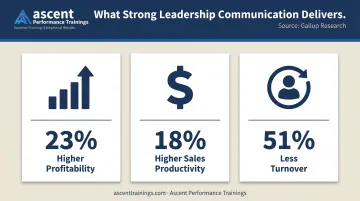
Gallup data reinforces the stakes: highly engaged teams show 23% higher profitability, 18% higher sales productivity, and 51% less turnover in low-turnover organizations. Each of those numbers traces back to specific communication habits — which is exactly what the seven skills below are built around.
The 7 Essential Leadership Communication Skills
Skill 1: Active Listening
Most leaders hear. Far fewer actually listen.
Active listening means attending to both the words and the emotions behind them — staying fully present, resisting the impulse to formulate a response while someone is still speaking, and engaging in ways that show genuine understanding.
The practical behaviors of active listening include:
- Sustained eye contact and open body language
- Avoiding interruptions, even when you already know the answer
- Paraphrasing back what you heard before responding
- Asking follow-up questions that demonstrate you absorbed what was said — not just the surface content
HBR's analysis of 3,492 participants in a manager coaching program found that the most effective listeners weren't simply quiet. They created cooperative conversations, made the other person feel valued, and offered thoughtful input at the right moment.
Active listening is the foundational skill because without it, leaders can't diagnose real problems, build trust, or adapt their approach to the person in front of them. Every other communication skill depends on it.
Skill 2: Clarity and Purposeful Messaging
Vague communication is expensive. When a leader's message lacks clear intent, teams fill the gaps with assumptions — and those assumptions rarely align.
Every leadership message should be anchored to a specific outcome. Before any significant conversation, email, or presentation, ask: What do I need people to understand, feel, or do differently after this? That single question forces precision and eliminates the habit of communicating to check a box rather than to drive action.
Common failure modes that erode message clarity:
- Assuming shared understanding when none exists
- Burying the key point in context or qualifications
- Using vague language ("let's move faster," "do better") without defining what that means
- Skipping the "why" entirely and just issuing the directive
Structure is the fix, not eloquence. Lead with the outcome, provide the necessary context, and confirm understanding before moving on. Leaders who communicate this way spend less time re-explaining decisions and less time managing the fallout from misaligned execution.
Skill 3: Empathy and Emotional Intelligence
In a leadership context, empathy isn't sympathy — it's the ability to understand a team member's perspective, concerns, and motivations without projecting your own reactions onto their situation.
The business case runs through psychological safety. Edmondson's foundational research established that psychological safety — the shared belief that a team is safe for interpersonal risk-taking — directly predicts team learning behavior and performance. Leader behavior is one of the primary drivers of that safety.
A 2023 review of 104 peer-reviewed articles confirmed that emotionally intelligent leaders improve both team behaviors and measurable business results.
Empathy is also communicated through action, not just words. Leaders who follow through on commitments, acknowledge when circumstances are genuinely hard, and actively invest in their team's growth signal empathy more powerfully than any single conversation. When employees feel understood, they surface problems earlier, take more initiative, and stay engaged through difficulty.
Skill 4: Giving Feedback and Recognition
Feedback is only effective when it's specific enough to be actionable. "Good job" is noise. "The way you handled that client objection on Thursday — you reframed the pricing concern before it derailed the deal — that's exactly the approach we need more of" is signal. It reinforces the exact behavior you want repeated.
Gallup's research puts numbers behind this:
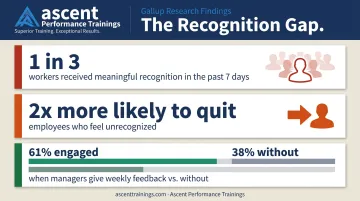
- Only 1 in 3 U.S. workers strongly agree they received meaningful recognition in the past seven days
- Employees who don't feel adequately recognized are twice as likely to say they'll quit within a year
- When managers provide both feedback and recognition at least weekly, 61% of employees are engaged, versus 38% when recognition is less frequent
The balance matters as much as the frequency. Leaders who only deliver feedback in moments of failure miss a critical opportunity — they create environments where employees associate feedback with getting something wrong rather than getting better. Regular recognition builds the psychological safety that makes developmental feedback land without defensiveness.
Skill 5: Conflict Resolution Through Communication
Conflict arises in any high-performing team. Avoidance just delays the friction — and lets it compound into dysfunction.
The leader's role in conflict isn't to pick a side or impose a solution. It's to redirect the conversation from blame and emotion toward future-focused problem-solving.
Key communication moves in conflict resolution:
- Separate people from problems — focus on the situation, not the person
- Listen to understand each party's underlying concern, not just their stated position
- Reflect back what you've heard before offering any response
- Facilitate agreement on a shared next step, even if full resolution takes time
Leaders who handle conflict well earn disproportionate trust and loyalty. Teams learn that difficult conversations are safe to have, which means problems surface faster and get resolved before they escalate. That track record is hard to build and easy to destroy — which is why avoiding conflict, even once, signals more than leaders often realize.
Skill 6: Adapting Communication Across Audiences and Channels
A message that lands perfectly in a board presentation will fall flat in a frontline team meeting. The content might be identical — the framing, depth, tone, and format need to be entirely different.
Effective leaders adjust based on:
- Who they're addressing — level of expertise, role, what they care about most
- What outcome they need — inform, align, motivate, or decide
- Which channel fits the moment — synchronous vs. asynchronous, formal vs. informal
The complexity multiplies at scale. HBR research on global teams found that 89% of white-collar workers at least occasionally complete projects in global virtual teams — and those teams face real cultural, linguistic, and contextual differences that affect collaboration. Cultural diversity creates both process gains (creativity, perspective) and process losses (miscommunication, coordination friction).
Navigating those differences requires more than theory. Tim Carlisle has delivered leadership training across 75+ countries, confronting firsthand how communication norms, feedback culture, and authority perception vary across regions and generations. That experience directly shapes how Ascent Performance Trainings builds audience adaptability into its leadership programs — as a practical, field-tested skill.
Skill 7: Communicating Vision and Purpose
Leaders who only communicate tasks get compliance. Leaders who connect daily work to a larger "why" get commitment.
The gap between these two is measurable. McKinsey found that 85% of executives report living their purpose at work — compared to just 15% of frontline managers and employees. That's not a motivation problem. It's a communication problem.
When managers consistently connect team members' work to organizational purpose, the effect is significant: employees with opportunities to link their work to a larger mission are nearly 3x more likely to feel their purpose is fulfilled at work. Those without such connection have only a 7% chance of that fulfillment.
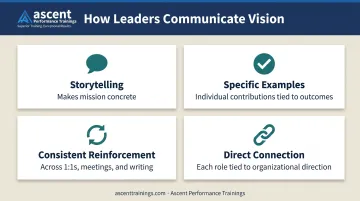
The practice of vision communication doesn't require grand speeches. It requires:
- Storytelling that makes the mission concrete, not abstract
- Specific examples showing how individual contributions shaped real outcomes
- Consistent reinforcement of the "why" across one-on-ones, team meetings, and written communications
- Direct connection between each person's role and the organization's larger direction
The goal is simple: every team member should be able to articulate why their work matters beyond their job description.
Warning Signs That Your Leadership Communication Needs Work
Most leaders overestimate the clarity and impact of their own communication. A PMC study of 38 mental health teams found that 44.7% of supervisors rated their own leadership higher than their teams did — and that gap in self-perception was directly associated with a more negative organizational culture.
Watch for these warning signs:
- Team members frequently ask for clarification on instructions already given
- Important problems surface late — because people don't feel safe raising them early
- Feedback conversations are consistently avoided or delayed
- Key decisions get relitigated after they've already been made
- Only 1 in 4 employees strongly agree their opinions count at work, per Gallup — that's a listening problem, not a strategy problem
The leaders who improve fastest are those who actively seek feedback on how they communicate — not just on the quality of their decisions. Start by asking your team one direct question: "What's one thing I could communicate more clearly?" The answers are rarely what you expect.
How to Develop Leadership Communication Skills
These skills are not fixed personality traits. They're behaviors — and behaviors can be learned, practiced, and reinforced through targeted development. Awareness helps, but awareness alone doesn't create change.
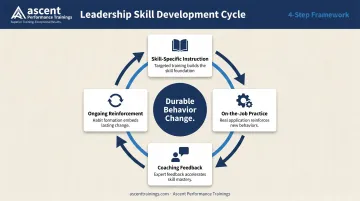
Effective development follows a specific pattern:
- Skill-specific instruction — targeted training on each behavior, not generic leadership content
- On-the-job practice — applying the skill in real situations immediately after learning it
- Coaching feedback — someone observing the application and providing specific, timely input
- Ongoing reinforcement — structured follow-up that sustains the new behavior past the initial learning spike
Research on habit formation by Lally et al. found that the average time to reach behavioral automaticity is 66 days, with a range of 18 to 254 days. A single workshop without follow-through rarely produces lasting change. The training event starts the process. What follows it determines whether the behavior actually sticks.
The Ascent Leadership Academy is built with this in mind. The 10-week program covers communication, emotional intelligence, decision-making, and team leadership through interactive workshops, real-world simulations, and practical frameworks. It's followed by an 8-week reinforcement program — weekly AI-curated videos and monthly one-on-one coaching sessions designed to convert new knowledge into durable on-the-job habits.
Tim Carlisle's PERFORM Leadership framework underpins the approach — built across 30+ years of training leaders in 75+ countries and across industries from financial services to oil and gas, where communication skills get tested in high-stakes, high-pressure conditions.
Frequently Asked Questions
What are the 5 important communication skills for leaders?
The five foundational skills are active listening, clarity, empathy, feedback delivery, and audience adaptability. These form the baseline every effective leader needs. More advanced leaders build conflict resolution and vision communication on top of that foundation.
What are the 5 C's of leadership?
The 5 C's are Clarity, Communication, Consistency, Commitment, and Courage. Each reinforces effective leadership — clarity shapes the message, consistency builds trust, and courage drives the difficult conversations most leaders avoid.
How can leaders improve their communication skills?
Start with honest self-assessment or direct team feedback to identify specific gaps. Then seek targeted training with practice and reinforcement built in — not just a workshop. Apply one new behavior at a time rather than trying to overhaul everything at once.
What is the difference between leadership communication and management communication?
Management communication focuses on instructions, processes, and accountability. Leadership communication focuses on vision, motivation, trust-building, and inspiring people to contribute beyond what's required. Both matter — the best leaders do both well.
Why is active listening considered the most important leadership communication skill?
Active listening is the gateway to every other skill. Without it, leaders can't accurately diagnose problems, build trust, or adapt their approach to the person in front of them. Remove it, and every other communication skill operates on flawed information.
How does emotional intelligence relate to leadership communication?
EQ is the foundation beneath communication skills. It determines a leader's ability to accurately read emotional cues and group dynamics, manage their own reactions, demonstrate empathy, and navigate difficult conversations without escalating them. Leaders with high EQ tend to communicate more precisely under pressure — exactly when it matters most.