
Introduction
The business environment heading into 2026 looks nothing like it did five years ago. AI is reshaping entire job functions. Hybrid teams span continents and time zones. Economic volatility has made long-range planning feel like guesswork. Against that backdrop, the gap between leaders who adapt and those who don't has widened significantly — and the consequences are measurable.
Leadership skills are no longer soft-skill supplements to technical expertise. According to the World Economic Forum's Future of Jobs Report 2025, 39% of workers' core skill sets are expected to be transformed or outdated by 2030.
Leadership and social influence has surged in response — now cited as critical by 61% of surveyed organizations, up 22 percentage points since 2023.
What follows is a practical breakdown of the 8 leadership skills that distinguish high-performing leaders in 2026 — and how to build them.
TL;DR: The 8 Key Leadership Skills for 2026
- Emotional Intelligence — recognize and manage emotions to build trust and make better decisions
- Agility and Adaptability — lead teams through disruption by treating change as an opportunity, not a threat
- Effective Communication — clear, audience-aware messaging across every channel — written, verbal, and virtual
- Visionary Thinking — connect daily work to long-term purpose so teams know where they're headed and why
- Employee Motivation and Engagement — tap both intrinsic and extrinsic drivers to keep performance high over the long term
- Conflict Management — identify friction early and facilitate honest dialogue before problems escalate
- Decision-Making Under Pressure — make confident calls on incomplete information while keeping your team's trust intact
- AI Literacy and Digital Fluency — know how to apply AI tools in ways that sharpen judgment rather than shortcut it
Why Leadership Skills Matter More Than Ever in 2026
Three forces are converging to raise the bar for leadership:
- AI integration — AI is automating routine tasks and shifting human work toward judgment, creativity, and coordination—all leadership-dependent activities
- Hybrid and distributed teams — managing performance, culture, and cohesion across time zones requires a different skill set than managing co-located teams
- Accelerating disruption — industries are being restructured faster than most organizations can adapt, putting constant pressure on strategic agility
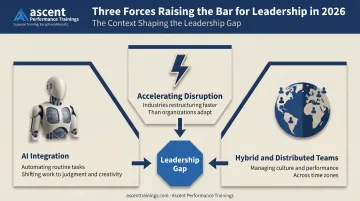
Together, these pressures expose a measurable leadership gap. LinkedIn's 2025 Workplace Learning Report found 49% of L&D and talent professionals worry that executives believe their employees lack the skills to execute business strategy.
Transactional vs. Transformational Leadership
The distinction matters more now than ever:
| Transactional Leadership | Transformational Leadership |
|---|---|
| Manages tasks and outputs | Inspires performance and growth |
| Reactive to problems | Proactively develops people |
| Focuses on short-term metrics | Aligns teams to long-term purpose |
| Compliance-driven | Commitment-driven |
Organizations in 2026 need the second column. Leaders anchored to transactional habits slow down the teams and strategies that depend on them most.
The 8 Key Leadership Skills You Need in 2026
Skill 1: Emotional Intelligence
Emotional intelligence (EI) is a leader's ability to recognize and regulate their own emotions—and to genuinely understand the emotional states of others. Most other leadership behaviors depend on it.
A 2022 Frontiers in Psychology meta-analysis found EI correlates with:
- Job performance (rho = 0.29)
- Organizational citizenship behavior (rho = 0.36)
- Lower job stress (rho = -0.43)
- Organizational commitment in managers (rho = 0.32, stronger than non-managers at 0.24)
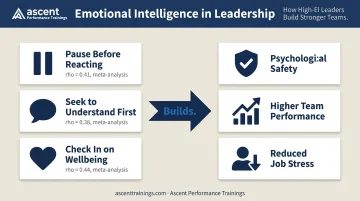
In practice, high-EI leaders do three things consistently:
- Pause before reacting — especially under stress, when poor decisions get made
- Seek to understand first — they ask questions before drawing conclusions about a team member's behavior
- Check in on wellbeing — not as a formality, but as a genuine practice that builds psychological safety
Psychological safety, in turn, is one of the strongest predictors of team performance. Leaders who invest in EI build the kind of environment where high performance becomes possible — and sustainable.
Skill 2: Agility and Adaptability
Agility means building a team culture where disruption is expected, not feared. Leaders who model adaptability give their teams implicit permission to experiment, adjust course, and learn from failure without shame.
Deloitte's 2025 Human Capital Trends report frames the challenge as "stagility"—organizations need to move fast while simultaneously giving workers the stability and predictability they need to perform. That tension lands squarely on the leader.
A practical framework for building adaptability:
- Create contingency plans — not because you'll need them all, but because the planning process trains your brain to think in scenarios
- **Own how you communicate change** — teams don't resist change; they resist poorly communicated change
- Audit your own comfort-zone behaviors — identify one habit that's slowing your team down and experiment with changing it first
The WEF's 2025 outlook explicitly identifies resilience, flexibility, and agility as top future-facing workforce skills. The leaders who model these behaviors are the ones who attract and retain top talent.
Skill 3: Effective Communication
Communication in 2026 means something more specific than "speaking clearly." It means:
- Active listening — fully processing what's said before formulating a response
- Channel clarity — knowing when to use async (Slack, email) versus synchronous (video, in-person) communication
- Audience adaptation — adjusting message, tone, and detail for frontline teams versus executives
- Written precision — especially critical in distributed and hybrid environments where misread messages create real friction
One of the most underrated communication skills is asking powerful questions rather than delivering all the answers. Leaders who ask better questions unlock better thinking, build ownership, and create psychological safety far more effectively than those who lecture or instruct.
Good questions also expose assumptions. "What's the biggest obstacle to hitting this deadline?" surfaces different—and more useful—information than "Is everything on track?"
Skill 4: Visionary Thinking
Vision without communication is just a wish. Leaders with genuine visionary thinking do two things that others don't: they see beyond the current quarter, and they articulate that picture consistently enough that teams can align daily decisions with long-term direction.
This matters because drift is expensive. When people don't understand where they're headed, they optimize for what's immediate and comfortable rather than what's strategically important.
How to develop your vision:
- Study industry trends—not just your sector, but adjacent industries that are being disrupted first
- Seek cross-functional perspectives; the best insights often come from people outside your immediate function
- Schedule protected thinking time away from operational noise—90 minutes per week changes what you're able to see
Visionary thinking is also the bridge between motivation and performance. When people understand the larger purpose behind their work, discretionary effort increases.
Skill 5: Employee Motivation and Engagement
Disengagement is not an HR problem—it's a leadership problem. Gallup estimates low employee engagement costs the global economy $8.8 trillion in lost productivity, or roughly 9% of global GDP.
The mistake many leaders make is treating motivation as a single lever. It isn't. Research in self-determination theory found that intrinsic motivation accounts for 46% of motivational effects and explains over 50% of variance in burnout and engagement—while purely external motivation (rewards, penalties) explains less than 10% of outcomes.
Practical motivation tactics:
- Regular one-on-ones — surface individual goals and frustrations before they become disengagement
- Public recognition — specific, timely acknowledgment of contributions (not generic praise)
- Connect work to purpose — help each team member understand how their role connects to something that matters
The leaders who fail here tend to focus on compensation and performance incentives while neglecting meaning. Money reduces friction; purpose drives performance.
Skill 6: Conflict Management
Conflict management is not about keeping the peace. It's about identifying friction early enough to address it constructively, before it calcifies into resentment or team dysfunction.
According to CPP's workplace conflict research, **85% of employees experience workplace conflict** to some degree. More recently, SHRM's Q4 2024 Civility Index found U.S. organizations lost over $2.7 billion per day from reduced productivity and absenteeism caused by workplace incivility—up over $600 million per day from just the prior quarter.
A practical conflict resolution approach:
- Separate people from the problem — the conflict is usually about interests, not personalities
- Identify underlying interests — what does each party actually need, beyond their stated position?
- Create solutions where both parties feel heard — resolution without acknowledgment rarely holds
Leaders who handle conflict well don't just solve the immediate problem. They build team trust—because people see that difficult conversations are handled with fairness.
Skill 7: Decision-Making Under Pressure
Every decision either builds or erodes leadership credibility. The challenge is that most decisions in 2026 involve incomplete information, time pressure, and genuine ambiguity. According to McKinsey research on decision-making, only 20% of organizations say they excel at decision-making, and 61% say most decision-making time is used ineffectively.
The trap is binary thinking: act decisively and risk being wrong, or gather more data and miss the window. The best leaders do neither—they use a structured approach.
A three-step decision framework:
- Frame — define the real problem, not the surface symptom. Most bad decisions solve the wrong thing
- Explore — surface two or three genuine alternatives and their trade-offs, not just option A versus doing nothing
- Decide — commit and communicate with conviction, while staying open to course-correcting as new data arrives
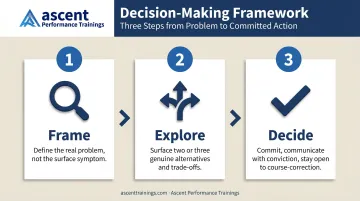
The third step is where many leaders struggle. Communicating a decision clearly—including the reasoning behind it—is what converts the decision into team action.
Skill 8: AI Literacy and Digital Fluency
AI literacy in 2026 is not a technical skill. It's a leadership skill. Leaders don't need to write code—they need to understand what AI can and cannot do, ask the right questions about how it applies to their team's work, and model a learning mindset toward new tools.
The stakes are real. According to Gartner, 81% of CIOs say GenAI skill gaps will block their 2025 objectives, and 63% of employees have not yet used GenAI in critical tasks. Meanwhile, McKinsey data shows generative AI use jumped from 33% in 2023 to 71% in 2024—an acceleration that outpaces most leaders' current understanding.
What digitally fluent leadership looks like in practice:
- Asking "Where is my team spending time on work that AI could handle?" before assuming the answer is nowhere
- Staying informed about AI developments in your specific industry, not just general tech news
- Encouraging experimentation without demanding perfection—teams learn AI tools faster when failure is low-stakes
- Evaluating AI-generated outputs critically rather than accepting them uncritically
The gap between AI-fluent leaders and those still on the sidelines is widening fast. The practical advantage goes to those who engage now.
How to Build These Skills: From Awareness to Action
Knowing which skills matter is only half the problem. The harder part is closing the gap between awareness and consistent behavior change—especially without a structured development path.
Most professionals can name their leadership gaps. Far fewer have a system to close them. The research supports structured development: 71% of organizations now offer leadership training as their most common career development practice, and 83% of career development champions plan to maintain or increase that investment.
What Effective Leadership Development Looks Like
High-impact programs share several characteristics:
- Multiple learning modalities — in-person workshops, live virtual sessions, and self-paced learning serve different needs and reinforce each other
- 1:1 coaching — personalized guidance that addresses individual gaps, not just group instruction
- Post-training reinforcement — structured follow-up that prevents the skill regression that derails most single-event training
Skills learned in a classroom erode quickly without reinforcement. Research from ATD shows that structured coaching after training is what converts a development event into durable behavior change—without it, most skills regress within 90 days.
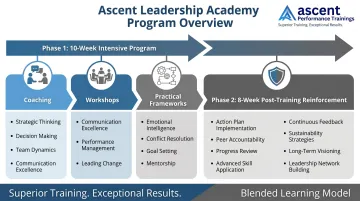
That reinforcement model is exactly what the Ascent Leadership Academy is built on. The 10-week program combines real-world coaching, interactive workshops, and practical frameworks across emotional intelligence, decision-making, strategic thinking, collaboration, and team leadership. What distinguishes it is what happens after: 8 weeks of post-training support—weekly AI-topic videos and monthly one-on-one coaching sessions—designed to embed skills into daily practice rather than let them fade.
Start With an Honest Self-Assessment
Before pursuing any program, take stock:
- Which of the 8 skills represents your biggest current gap?
- What's one behavioral experiment you could run this week? (Try genuine active listening in your next team meeting—no interrupting, no problem-solving until the other person is fully finished.)
- Do you have a structured development path, or are you relying on experience alone to build new skills?
Experience builds context. Deliberate practice with structured feedback is what actually moves the needle on specific skill gaps.
Frequently Asked Questions
What are the most important business leadership skills to develop?
Emotional intelligence, communication, adaptability, and decision-making consistently rank at the top across research and practitioner surveys. That said, the most important skill depends on your current role and your organization's specific challenges—a leader managing rapid headcount growth has different priority gaps than one navigating a team restructure.
Can leadership skills be learned, or are they innate traits?
All core leadership skills are learnable. Some personality traits provide a head start with certain skills, but research consistently shows that deliberate practice, quality feedback, and structured development produce meaningful behavioral change. The "natural leader" is mostly a myth.
How do you know which leadership skills you need to improve?
The most reliable methods are 360-degree feedback, validated self-assessments (DISC, EQ assessments), and honest conversations with a mentor or coach. High performance in your current role doesn't always predict readiness for the next level—skill gaps often only surface once the role changes.
What is the difference between leadership skills and management skills?
Management focuses on processes, systems, and execution—getting work done reliably and efficiently. Leadership focuses on vision, motivation, and people development—inspiring people to do work that matters. Strong leaders combine both, but the higher you go in an organization, the more leadership capability matters relative to management mechanics.
How long does it take to develop strong leadership skills?
Behavioral change—where a new skill shows up consistently under pressure—typically takes 3–6 months of deliberate practice with feedback and reinforcement. Awareness can develop faster, but that alone doesn't move the needle. High-performing leaders never stop developing; the skills ceiling keeps moving.
Why is emotional intelligence considered such a critical leadership skill?
EI underpins almost every other leadership behavior. Leaders with low EI make reactive decisions, struggle with conflict, and erode the psychological safety their teams need to perform well. High-EI leaders build trust faster, retain talent more effectively, and drive stronger outcomes—which is why EI tops nearly every credible leadership framework.