
Introduction
You invest in a two-day sales training event. Reps leave energized, notebooks full of frameworks, ready to close. Then Monday happens. By Friday, the new objection-handling technique is gone, crowded out by old habits. By the following month, quota numbers look identical to what they were before.
This isn't a training quality problem. It's a biology problem.
The human brain discards information it doesn't repeatedly use. Without deliberate follow-through, even excellent training fades — and your investment goes with it.
According to ATD, approximately 50% of sales training content isn't retained after five weeks. That figure climbs to 84% by the 90-day mark.
This article covers what post-training reinforcement actually is, why the forgetting curve makes it non-negotiable, which strategies work, and how to build a reinforcement plan your sales team will actually follow.
TLDR
- Post-training reinforcement re-engages learners to move knowledge from short-term to long-term memory
- Memory retention drops sharply within the first 24–48 hours — making early follow-up critical
- The most effective methods: spaced repetition, retrieval practice, microlearning, and manager coaching
- Use the 2-7-14-30 interval model to time reinforcement touchpoints strategically
- Measure ROI by linking CRM data, completion metrics, and manager observations
What Is Post-Training Reinforcement?
Post-training reinforcement is a structured learning strategy that uses spaced follow-up content, retrieval practice, and deliberate repetition to extend learning beyond the initial training event — turning knowledge into on-the-job behavior.
Most organizations confuse reinforcement with repetition. These are not the same thing:
- Resending training slides does not reinforce — it reminds
- Scheduling a recap webinar two weeks later restates content without testing recall
- Assigning a passive review module lets learners recognize information rather than reconstruct it
Real reinforcement is active. It prompts recall. It challenges learners to retrieve knowledge from memory — which is the mechanism that actually builds retention.
Why Sales Teams Need It Most
Sales skills decay faster than most people expect. Objection handling, consultative discovery, and closing techniques are high-frequency, high-pressure behaviors. Without repeated practice in context, they revert to instinct — which usually means old, less effective habits.
For sales teams specifically, reinforcement is what converts a training event into sustained quota performance. A workshop teaches the framework. Reinforcement is what makes it instinctive when it counts.
Why Most Training Fails Without Reinforcement
The Forgetting Curve
Hermann Ebbinghaus mapped memory decay in his 1885 experiments, and the pattern is consistent: retention drops steeply within the first 24–48 hours. In his original data, savings in recall fell to 33.7% after one day, 27.8% after two days, and 21.1% after 31 days. A 2015 replication by Murre and Dros in PLOS ONE confirmed the curve holds across modern subjects — the pattern is not an artifact of 19th-century lab conditions.
The brain prioritizes information it encounters repeatedly. One exposure to a sales framework doesn't send a strong enough signal that this information matters. Without reinforcement, it gets deprioritized and eventually pruned.
The Four Steps Most Training Skips
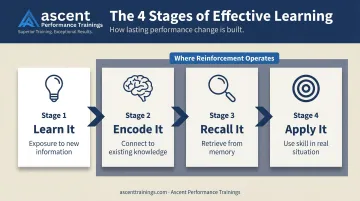
Effective learning requires four stages:
- Learn it — exposure to new information
- Encode it — initial understanding and connection to existing knowledge
- Recall it — retrieving the information from memory
- Apply it — using the skill in a real situation
Most corporate training programs address only Step 1. They're heavy on exposure and light on everything that makes the knowledge stick. Reinforcement is what drives Steps 2 through 4.
The Financial Reality
U.S. organizations spent $102.8 billion on corporate training in 2024–2025, according to the Training Magazine 2025 Training Industry Report. When training doesn't transfer to behavior (because reinforcement is absent) the majority of that spend produces no lasting performance change.
For sales teams, the consequences are concrete: missed quotas, weak discovery calls, longer ramp times for new hires, and lost revenue that never shows up in any training budget line.
The forgetting curve follows a known trajectory. That makes it addressable — provided the training design includes spaced retrieval, manager reinforcement, and applied practice after the classroom ends.
Proven Strategies to Reinforce Sales Training
Spaced Repetition
The core idea: deliver reinforcement content at increasing time intervals, timed to interrupt forgetting before it becomes permanent. Each retrieval attempt just before the memory fades strengthens the trace significantly more than massed review.
A 2006 meta-analysis by Cepeda et al. synthesizing 317 experiments found that the benefits of spaced practice are robust and consistent across subjects and content types. The research is clear — spacing matters more than volume.
The 2-7-14-30 model for sales teams:
| Interval | Content Type |
|---|---|
| Day 2 | Short recall quiz or reflection prompt |
| Day 7 | Microlearning video (2–5 min) on a key concept |
| Day 14 | Role-specific scenario or application exercise |
| Day 30 | Manager coaching review + skills observation |
The format is secondary. Digital flashcards, email-based quiz bursts, or short scenario modules all work — the interval is what matters.
Retrieval practice amplifies those intervals further, and it works differently than most managers expect.
Retrieval Practice
Research by Roediger and Karpicke in Psychological Science (2006) found something counterintuitive: learners who repeatedly tested themselves on material retained 56% after one week, compared to 42% for those who repeatedly re-studied the same content. Testing outperforms re-studying — by 14 percentage points after just one week.
The mechanism is effortful recall. When a learner struggles to retrieve an answer from memory, the act of searching strengthens the neural pathway far more than passively re-reading it. This is why difficult questions — even ones learners get wrong initially — produce better long-term retention than easy review prompts.
Practical application:
- Send recall questions 24–48 hours after training (not reviews)
- Design questions that require reconstruction, not recognition
- Deliver the correct answer after the attempt — the contrast strengthens encoding
- Don't worry about high scores early. Struggle is the mechanism, not a failure signal
Once spacing and retrieval are in place, microlearning and manager coaching determine whether those gains carry into actual selling behavior.
Microlearning and Coaching
Microlearning works as a delivery vehicle for spaced content: 2–5 minute videos, one-page job aids, or short scenario exercises that revisit key skills without pulling reps off the floor. The format keeps relevance high and time investment low.
Manager-led coaching is the highest-impact reinforcement method. Managers who are briefed on training content before it happens can observe actual call behavior, identify gaps in context, and deliver specific, timely feedback. A 2014 review by Govaerts and Dochy found that supervisor support has a stronger relationship with training transfer (effect size .31) than peer support (.14).
Schedule manager coaching reviews at 30, 60, and 90 days post-training — not just once.
Ascent Performance Trainings' 8-week post-training reinforcement program applies this directly: weekly video content delivered by email revisits classroom skills at spaced intervals, while monthly one-on-one coaching sessions provide individualized feedback and goal tracking — the same cadence the research supports.

How to Build a Post-Training Reinforcement Plan
A reinforcement program designed after training is already late. Build it alongside the training — not as an afterthought.
Step 1: Define What "Good" Looks Like Before Training Begins
Identify the specific behaviors you want to change. For each role — SDR, AE, Customer Success — document what successful application of the training looks like in day-to-day work. If you can't describe it concretely, you can't reinforce it.
Step 2: Map Content to the 2-7-14-30 Intervals
Assign format by timing:
- Days 1–2: Recall prompts and short quizzes
- Week 1–2: Microlearning videos and scenario exercises
- Weeks 3–4: Role-specific application challenges and reflection questions
- Days 30/60/90: Manager coaching reviews
Step 3: Brief Managers Before Training, Not After
Equip managers with the training outcomes, behavioral indicators to watch for, and specific coaching questions. Manager involvement is the single biggest predictor of whether training transfers — a manager who doesn't know what was taught has no framework for reinforcing it.
Step 4: Build Peer Accountability Into the Plan
Peer learning pairs and team huddles where reps share how they've applied specific skills activate social learning. This is the "20%" in the 70-20-10 framework — frequently the most neglected component in reinforcement planning. Done consistently, it sustains momentum between manager check-ins.
Step 5: Differentiate by Role
An SDR reinforcing prospecting scripts needs different content than an AE reinforcing negotiation technique. Role-specific paths increase relevance and adoption — and keep participants engaged throughout the full reinforcement cycle.
The 70-20-10 Framework: Where Reinforcement Lives
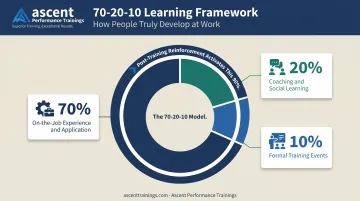
The 70-20-10 model, developed from Center for Creative Leadership research, proposes that learning comes from:
- 70% on-the-job experience and application
- 20% coaching and social learning
- 10% formal training events
The 70-20-10 proportions are a heuristic, not a validated measurement ratio — ATD's own 2014 critique acknowledged the model lacks strong empirical evidence as fixed percentages. The directional insight still stands: formal training alone is a small fraction of what drives lasting performance change.
That's precisely where reinforcement enters. The formal training event (the 10%) is the entry point. Post-training reinforcement activates the other 90% — by creating deliberate practice opportunities (the 70%), structured coaching touchpoints (the 20%), and peer learning moments throughout. Organizations that treat training as the finish line are ignoring the majority of the learning equation.
Measuring Reinforcement ROI
No single metric tells the full story. Use three data sources together:
Leading indicators (shows whether reinforcement is being engaged with):
- Quiz completion rates and scores
- Coaching session attendance
- Skill assessment progress on the learning platform
Lagging indicators (shows whether it's producing results):
- Quota attainment and win rate
- Deal velocity and close rate
- New hire ramp time to first close
Manager observational data:
- Behavioral changes noted in 1:1s
- Field coaching observations
- Specific skill application in calls or meetings
The numbers make the case clearly. According to CSO Insights 2019, organizations with 90%+ sales process adoption hit 112.5% revenue plan attainment and 57.8% win rates — compared to study averages of 102.5% attainment and 46.4% win rates for lower-adoption organizations.
For organizations new to measuring reinforcement:
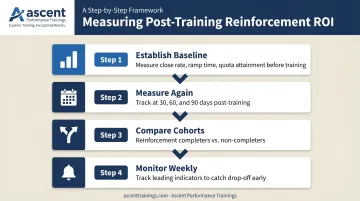
- Establish a baseline on 2–3 key metrics before training (close rate, ramp time, quota attainment)
- Measure again at 30, 60, and 90 days post-training
- Compare cohorts who completed reinforcement versus those who didn't
- Track leading indicators weekly to catch drop-off early
Once those baselines are in place, the ROI Institute's five-level framework gives you a structured path from soft signals to hard business results: reaction (Level 1), learning (Level 2), application (Level 3), business impact (Level 4), and financial ROI (Level 5). Each level adds a sharper layer of proof for reinforcement's contribution to performance.
Frequently Asked Questions
What is a post-training reinforcement program?
A structured series of follow-up activities — quizzes, coaching sessions, microlearning videos, and practice scenarios — designed to help learners retain and apply training content over time. It replaces the one-and-done workshop model with an ongoing learning process that builds durable behavior change.
What is the 70-20-10 rule for training?
A learning heuristic suggesting 70% of development comes from on-the-job experience, 20% from coaching and social learning, and 10% from formal training. Post-training reinforcement activates that full 90% by creating practice opportunities, coaching touchpoints, and peer learning moments after the formal event ends.
What tools or formats work best for post-training reinforcement?
Short-burst microlearning videos, scenario-based quizzes, manager coaching check-ins, and peer practice exercises are the most effective formats. The strongest programs mix digital tools for recall with human touchpoints — like coaching sessions — for skill application and accountability.
How soon after training should reinforcement begin?
Within 24–48 hours — before the forgetting curve steepens. Start with short recall prompts or reflection questions, then continue at 7, 14, and 30-day intervals to interrupt memory decay at its most critical points.
What is the forgetting curve and why does it matter for training?
Ebbinghaus's forgetting curve shows that retention drops to roughly a third within 24 hours of learning. For sales teams, that means skills from a morning workshop can be forgotten before the first real conversation — which is exactly why reinforcement can't wait.
How do you measure whether post-training reinforcement is working?
Track leading indicators (quiz scores, coaching attendance, skill assessments) alongside lagging indicators (close rates, ramp time, quota attainment), measuring both before training and at 30, 60, and 90 days out. The spread between those two data sets tells you exactly what reinforcement is delivering.