
Introduction
Most sales professionals approach high-net-worth (HNW) clients the same way they approach everyone else — a polished pitch, objection handlers, and a closing push. And they consistently walk away empty-handed.
HNW clients aren't a harder version of a standard buyer. They're a fundamentally different challenge that requires a different posture, not just different scripts.
These are individuals who have been pitched constantly, who can detect desperation faster than most people can finish a sentence, and who have access to alternatives you'll never know about.
This guide covers:
- The psychology behind how HNW individuals actually make decisions
- The five closing techniques that work with this demographic — and why
- How to set up the close before you ever enter the room
- The mistakes that quietly kill deals at the final stage
If that's the work you're doing, what follows is worth reading carefully.
TLDR
- HNW clients buy on trust, strategic fit, and exclusivity — price and pressure rarely move them
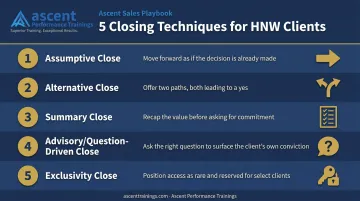
- The five most effective closing techniques: Assumptive, Alternative, Summary, Advisory/Question-Driven, and Exclusivity Close
- Pre-meeting credibility and referral positioning often outweigh what you say in the room
- Soft closes and advisory language consistently outperform hard closes with sophisticated buyers
- HNW objections signal a need for more trust — respond with depth, not pressure
Why Standard Closing Techniques Fall Flat with HNW Clients
High-pressure tactics — manufactured urgency, aggressive follow-ups, classic hard closes — tend to backfire with HNW buyers. These individuals have been pitched relentlessly throughout their careers. They recognize manipulation quickly, and when they do, the relationship ends.
That resistance runs deeper than preference — it's structural. Bank of America Private Bank's research on wealthy Americans found that 90% of wealthy individuals use a financial advisor, and 67% use multiple professionals to manage their financial affairs. Attorneys, CPAs, and private bankers often act as informal validators — or outright gatekeepers — before any significant commitment is made.
On the seller side, the picture is just as complex. Capgemini reported that the average UHNW client held seven wealth-management relationships in 2023, up from three in 2020. These are buyers with no shortage of options and no reason to rush.
What this means practically:
- Patience and consistency outperform pressure every time
- Your close depends on trust that was built well before the final meeting
- Third-party validation from trusted advisors can advance a deal faster than any pitch technique
- The decision cycle spans multiple people, multiple conversations, and several distinct checkpoints
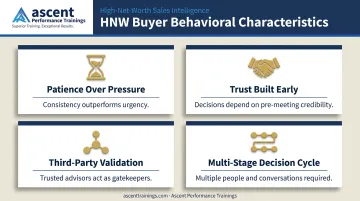
For HNW clients, the close is rarely a moment — it's the outcome of a process that was either built carefully or wasn't built at all.
The Psychology Behind HNW Decision-Making
What Actually Motivates HNW Buyers
Standard buyers are often motivated by price, features, and immediate gains. HNW clients have a different hierarchy entirely.
EY's 2025 Global Wealth Research Report found that 86% of wealth-management clients consider preserving and protecting wealth extremely or very important — not growing it aggressively. Legacy is equally prominent: 81% expect to leave an estate to a spouse or children, while 50% of families feel underprepared for intergenerational wealth transfer.
This means a pitch centered on returns and features misses what these buyers care about most. The emotional core is protection, continuity, and access — not growth percentages.
Key motivators for HNW clients:
- Prioritize protecting existing wealth over chasing higher returns
- Focus on legacy continuity, not quarterly performance numbers
- Seek access to opportunities unavailable to the general market
- Expect advisors to be direct, prepared, and respectful of their time
The "I Don't Need You" Dynamic
HNW clients are highly attuned to desperation. The moment a sales professional appears overeager, the perceived value of their offering drops. Projecting calm confidence — and even measured selectivity about who you work with — is a strategic move, not arrogance.
This isn't about being cold. It's about signaling that you have standards, which implies you have value. That same dynamic extends to how you structure your offering — specifically, what you make genuinely scarce.
How Exclusivity Creates Genuine Pull
Authentic scarcity works. Manufactured scarcity doesn't. A 2024 peer-reviewed study found that perceived natural rarity positively predicts functional, social, and emotional value, while manipulative or artificial scarcity has a negative relationship with emotional and social value perceptions.
When a professional communicates genuine limits — a defined client roster, minimum engagement criteria, selective intake — it triggers real interest. HNW individuals are drawn to what few others can access. The practical implication: if your exclusivity is real, say so plainly. If it isn't, don't manufacture it — they'll notice.
The Emotional Layer Beneath the Analytical Surface
Capgemini found that 65% of HNWIs acknowledge that cognitive biases and emotions affect their investment decisions, and 79% believe advisor guidance can help mitigate those biases. HNW clients appear analytical, but they are significantly influenced by how understood and validated they feel.
In practice, this means asking questions that go beyond financial goals — understanding family dynamics, risk anxieties, and what "success" actually means to that individual. Credentials open the door; the quality of your listening determines whether you stay in the room.
The 5 Best Closing Techniques for High-Net-Worth Clients
Assumptive Close (Adapted for HNW)
The assumptive close gets a bad reputation because most people apply it as pressure. With HNW clients, the goal is different: confidently advancing to next steps based on positive signals already present in the conversation.
Example language: "Once we structure this, the logical starting point would be a review of your current allocation against your preservation goals."
The key is framing forward motion as logical progression, not pressure. You're not pushing a decision — you're treating their implicit interest as a given and mapping the natural path forward.
Alternative Close
Giving a HNW client two paths that both advance the relationship preserves their sense of control while keeping momentum. Neither option is a hard no — both paths move the engagement forward.
Example language: "Would it make more sense to begin with a review of your estate structure, or address the portfolio rebalancing first?"
HNW individuals resist feeling steered. Offering a genuine choice satisfies that need for autonomy while still moving the engagement forward.
Summary Close
Before any closing moment, recap the client's stated goals, pain points, and how your solution addresses each — using their own words wherever possible.
The client hears their own priorities reflected back with precision — and that builds far more confidence than any pitch could. The summary close lands hardest when it proves you were listening during discovery, not just waiting for your turn to talk.
Advisory/Question-Driven Close
Open-ended questions that invite a HNW client to self-assess their own readiness are among the most effective tools available:
- "How do you see this fitting into your broader goals for the next three to five years?"
- "What would make this feel like the right move to take forward?"
When clients articulate their own reasoning for moving forward, they become the architects of the decision. That shift — from persuasion target to active participant — is what HNW buyers respond to. You're a thinking partner in the room, not someone running a close on them.
Exclusivity Close
Authentically communicating limited availability or selective intake creates genuine pull:
Example language: "We work with a defined number of clients each quarter to ensure the depth of service each engagement requires. I want to make sure we have the right fit before moving forward."
The word "authentically" matters here. HNW clients will immediately detect false scarcity — and it will cost you the relationship. This close only works when it reflects a genuine standard you actually hold.
Knowing these techniques is a starting point. Building them into instinct takes deliberate practice, realistic scenario work, and reinforced coaching over time — which is precisely where structured training programs make the difference.
Setting Up the Close: Pre-Meeting Positioning
The close for a HNW client often begins before any direct conversation takes place. These prospects will research you — your LinkedIn profile, your content, your reputation, and what others say about working with you. By the time they agree to a meeting, they've already formed an initial impression.
Build Credibility Before the First Conversation
A credibility-signaling digital presence for HNW markets includes:
- A clearly defined niche, not a generic "I work with everyone" positioning
- Thought leadership content that demonstrates expertise, not just promotion
- Social proof from credible clients or respected organizations
- A consistent, professional brand across all visible channels
Capgemini found that 55% of HNWIs say digital channel experience is a critical factor when selecting a wealth-management firm. That means your LinkedIn profile, website, and published content are doing sales work before you ever get on a call.
Enter Through Centers of Influence
Cold outreach rarely works with HNW prospects. Referrals from people already in their trust circle carry disproportionate weight.
Two data points make this clear:
- Cerulli research shows 69% of new advisory clients come from referrals — existing clients, family, or centers of influence like CPAs and attorneys
- EY found 37% of wealthy clients ranked peer recommendations as a top-three factor in choosing a primary wealth-management provider
Actively cultivate relationships with attorneys, private bankers, and accountants who serve the same clientele you're targeting. For HNW acquisition, this is the highest-leverage channel available.
Lead with Diagnosis, Not Pitch
The first meeting with a HNW prospect should be built around discovery, not presentation. Lead with questions that uncover:
- Their current situation and what's working
- What's missing or creating friction
- What success looks like in their terms
When prospects feel heard rather than pitched to, trust builds faster. You also walk away with the intelligence needed to personalize each step that follows — including the close itself.
How to Handle Objections from HNW Clients
Reframe What an Objection Actually Means
With HNW clients, an objection is almost never a hard no. It's a signal — a request for more trust, more clarity, or more evidence of fit. How you respond to that signal shapes the entire direction of the conversation.
Common HNW Objections and How to Respond
| Objection | Response Approach |
|---|---|
| "Your fees are high" | Ask what they're comparing it to. Anchor to the cost of the problem remaining unsolved. |
| "I already have an advisor" | Ask what's working well and what they'd want to see more of. Create a gap, don't attack the relationship. |
| "I need more time to think" | Ask what specific information would make the decision clearer. Unpack what's actually unresolved. |
| "The timing isn't right" | Acknowledge, then ask what would need to change for the timing to work. Set a defined follow-up point. |
The pattern across all four: respond with curiosity, not defensiveness. Questions signal confidence. Justifications signal anxiety.
Reduce Scope, Not Price
When fee resistance surfaces, the wrong move is discounting. Discounting signals that you didn't believe in your price to begin with — and HNW clients equate that with quality doubt.
The right move is offering a phased entry: a pilot engagement or a narrowed first stage that lowers the barrier without undermining the full offer. Your pricing stays intact — and the client gets a lower-risk way to experience the value before committing fully.

Common Mistakes That Kill HNW Deals
Over-talking and over-explaining. Verbosity reads as insecurity to a sophisticated buyer. HNW clients respect brevity, precision, and the confidence to let silence do its work. Ask a well-crafted question, then wait. The advisor who asks "what would make this feel right to move forward?" — then actually waits — projects the calm authority HNW clients gravitate toward.
Discounting or apologizing for your pricing. Research on price perception consistently shows that when buyers see premium pricing, they infer superior quality and exclusivity. The moment you volunteer a price reduction, you undermine that inference. Anchor firmly to value, reframe cost against the cost of inaction, and never be the first to suggest a discount.
Treating the conversation transactionally. Generic proposals, premature pitching, or failing to reference the client's specific stated goals all signal the same thing: you see them as a revenue opportunity, not a strategic relationship. HNW clients close with advisors they trust as partners. Any behavior that signals otherwise ends the deal quietly — they simply stop returning calls.
Frequently Asked Questions
What are the 5 closing techniques?
The five most effective closing techniques for HNW clients are the Assumptive, Alternative, Summary, Advisory/Question-Driven, and Exclusivity Close. Each must be adapted for a trust-first, low-pressure environment — the goal is forward motion through confidence and clarity, not persuasion through pressure.
How do you sell to high-net-worth individuals?
Selling to HNW individuals means replacing the pitch-and-persuade model with an advisory approach. Lead with diagnostic questions, demonstrate genuine selectivity, and use soft commitment language rather than pressure tactics at the close.
How is closing HNW clients different from standard sales?
HNW clients operate on longer trust-building cycles, make decisions through a circle of advisors, and prioritize strategic fit over price. The standard sales playbook doesn't apply — your posture must shift toward patience, credibility, and personalization throughout.
What closing mistakes should you avoid with HNW clients?
The three most damaging mistakes are over-explaining (signals insecurity), discounting on price (signals low conviction in your own value), and being transactional (signals you see them as a deal, not a relationship). Each of these is a disqualifier for sophisticated buyers.
How long does it typically take to close a HNW client?
HNW deals rarely close in a single meeting. Expect multiple touchpoints across weeks or months depending on referral strength, relationship depth, and deal complexity — plan your follow-up strategy accordingly.
What role does trust play in closing HNW deals?
Trust is the primary currency in HNW sales. No technique compensates for its absence, and when it's genuinely established, the close becomes a natural next step rather than a persuasion challenge.