
Executive leadership style isn't a soft, feel-good variable — it's a direct driver of quota attainment, rep retention, and the kind of team culture that either compounds results or quietly erodes them. Yet many executives underestimate how closely their behavior is watched, how quickly it shapes morale, and how fast that morale translates into measurable revenue impact.
This article covers the four leadership styles most relevant to sales organizations, how each one affects specific performance outcomes, the behaviors that silently damage results, and how executives can adapt their approach to build a more resilient, high-performing team.
TL;DR
- Transformational leadership drives long-term engagement; transactional approaches fuel short-term results but accelerate burnout.
- Reps carry real financial risk daily — executives who ignore this lose trust quickly.
- Executive leadership sets culture and trajectory; managers drive daily results. Both matter, differently.
- Blame culture, shifting expectations, and dismissiveness are top reasons high performers leave.
- Leaders who adapt their style to team maturity and market conditions build the most resilient sales organizations.
The 4 Executive Leadership Styles and Their Sales Impact
Most executives blend leadership styles, but under pressure, they revert to a default. Understanding which default you're running — and what it costs — is where the real self-awareness work begins.
The four styles most relevant to sales organizations are transformational, transactional, autocratic, and visionary.
Transformational Leadership
Transformational leaders function as mentors and culture architects. They develop individual reps while connecting daily sales effort to a larger organizational purpose. Their focus on coaching and professional growth produces higher engagement and tends to keep top performers around longer.
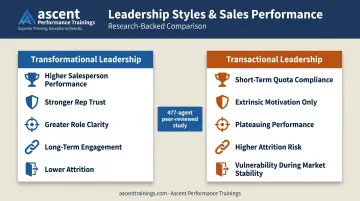
A peer-reviewed study of 477 sales agents found that transformational leader behaviors had stronger direct and indirect relationships with salesperson performance than transactional behaviors, with trust and role clarity acting as key mediators. This style is especially effective in fast-changing or innovation-driven markets where rep initiative and adaptability matter.
Transactional Leadership
Transactional leaders run a clear exchange: hit your number, earn your reward. This motivates compliance and drives short-term results, which isn't nothing. Over time, though, it suppresses intrinsic motivation. Reps recognized only for output, never for growth or initiative, plateau. When a competitor offers a slightly better commission structure, they leave. There's no deeper loyalty holding them.
One notable exception: during high environmental uncertainty (a market crisis, a major disruption), research shows transactional leadership can outperform transformational at maintaining performance. The right style depends heavily on context.
Watch for these signals that transactional leadership is dragging performance:
- Reps hit quota but show no initiative beyond minimum requirements
- Pipeline quality declines even when activity metrics look healthy
- Top performers start taking recruiter calls
Autocratic Leadership
Autocratic leaders make decisions unilaterally and prioritize speed and control. During acute pressure (a product launch, a competitive threat, a crisis), this reduces confusion and moves things quickly. Sustained autocratic leadership is a different story. It stifles rep initiative, erodes psychological safety, and pushes high performers out. High performers have options; they don't stay where their judgment isn't valued.
Visionary Leadership
Visionary leaders connect individual sales effort to a compelling organizational future. They communicate heavily, invest in emotional intelligence, and build the kind of buy-in that carries a team through difficult quarters. This style is particularly effective for turning around underperforming teams. Reps who understand why the work matters persist longer and sell more authentically.
How Leadership Style Shapes Sales Performance Metrics
Leadership impact in sales organizations operates on two distinct levels, and confusing them is a common executive mistake.
Executive-level leadership (directors and above) shapes culture, strategic alignment, and long-term performance trajectories. Manager-level leadership drives daily results through active coaching and real-time guidance. Executives who don't understand this distinction tend to over-index on operational pressure rather than strategic direction, and the effects show up in rep performance and morale.
Quota Attainment and Coaching Culture
The connection between leadership behavior and quota outcomes is well-documented. According to CSO Insights, organizations with dynamic coaching cultures achieved 21.3% higher quota attainment and 19.0% higher win rates compared to those relying on random or informal coaching. Yet 62.9% of organizations hadn't moved beyond informal coaching at the time of the study.
The tone set at the executive level — whether to invest in people or leave them to figure it out — cascades through every layer of management beneath it. That choice shows up directly in quota numbers.
Rep Retention and Engagement
Top sales performers are, by definition, marketable. They have relationships, track records, and skills that transfer. They also leave toxic or unsupportive environments faster than most, because their options are wider.
CSO Insights data puts hard numbers to the cost of disengagement:
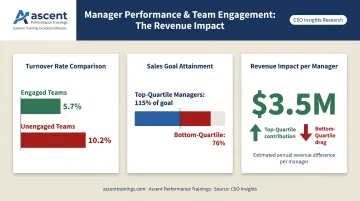
- Fully engaged sales forces see 5.7% voluntary turnover vs. 10.2% for unengaged teams
- Top-quartile sales managers drive 115% of team goals; bottom-quartile managers reach only 76%
- That performance gap translates to an estimated revenue difference of ~$3.5M per manager
This isn't just a people problem. Each percentage point of unnecessary turnover represents pipeline disruption, ramp time, and lost institutional knowledge.
The Tenure Paradox
Long-tenured leaders can be an organization's greatest asset — or a quiet drag on performance. The same Highspot/CSO Insights report found managers with more than 10 years of experience led only 55% of sellers to quota, compared to 48% for managers with less experience. The gap isn't dramatic, but it points to a real risk: leaders who stop updating their approach to match current market realities.
The risk is stagnation, not experience itself. Experienced leaders who stay adaptive become invaluable mentors to mid-level managers, passing down judgment and institutional knowledge that no classroom program can fully replicate.
The Trust Factor: What Sales Reps Need from Executive Leadership
Sales reps carry a level of financial risk that most other employees don't. Their income depends on product quality, market conditions, customer support, and dozens of decisions made above them — factors they don't control. Executive leaders who treat this reality as irrelevant create resentment that compounds quickly.
The Psychological Contract
There's an implicit agreement between sales reps and their organizations: reps bet on the company, the product, and the leadership. When executives communicate doubt, blame sales during bad quarters without acknowledging systemic issues, or dismiss rep concerns as excuses, they break that contract. The first people to walk are usually the strongest performers, because they have options.
Salesforce's 2026 Trends in Sales Compensation Report found that 74% of sales reps don't trust how their compensation is calculated, 47% feel their pay isn't fair, and only 25% hit 100% or more of quota in 2025. That's the environment your sales team is operating in. Leadership that ignores this financial reality loses credibility quickly.
What Trust-Building Looks Like in Practice
The difference between trust-building leadership and its absence comes down to specific behaviors, not grand gestures:
What it looks like:
- Defending the team from unfair internal criticism
- Publicly acknowledging the risk reps carry in variable-comp roles
- Communicating honestly when product issues or market conditions are affecting deal flow
- Removing internal obstacles (slow procurement approvals, unresponsive support teams) that slow deals
What it doesn't look like:
- Attributing a missed quarter entirely to "sales execution" when product, pricing, or competitive factors were clearly at play
- Staying silent when other departments undervalue or dismiss the sales function
- Announcing new targets without context or explanation
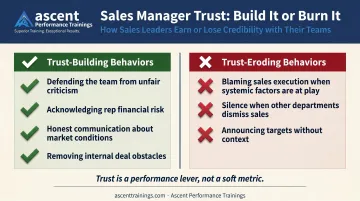
These behaviors aren't soft leadership — they're performance levers. When reps feel their executive is genuinely in their corner, they surface pipeline risks early and push through difficult sales cycles instead of quietly disengaging. Research on psychological safety is consistent: teams that feel safe enough to flag problems outperform those that don't, and that culture is set from the executive level down.
Leadership Behaviors That Quietly Kill Sales Performance
The behaviors that do the most damage to sales performance rarely show up in a pipeline review. They show up in exit interviews.
The Blame Default
The most destructive executive pattern is attributing poor results entirely to the sales team without examining product fit, pricing, market conditions, or internal support gaps. When that happens, reps stop surfacing real pipeline problems — because honesty gets punished. Forecast accuracy deteriorates. Leadership starts making decisions on data that no longer reflects reality, and the gap widens.
The "We Do All the Work" Mentality
When executives or leaders from other departments publicly undervalue the sales function — treating it as order-taking rather than value creation — it signals to reps that their contribution isn't understood or respected. Motivation erodes. High performers start listening to recruiters.
Shifting Expectations Without Context
When targets, messaging, or strategy change without clear rationale, reps can't build momentum. Chronic role ambiguity drives disengagement faster than a missed quota ever will. In sales, it shows up as:
- Reduced activity levels on long-cycle opportunities
- Disengagement from accounts that require sustained effort
- Increasing reliance on low-risk, low-reward deals that can be closed quickly
Consistent executive communication — even when the news is difficult — is one of the cheapest performance investments available.
How to Adapt Your Leadership Style for Stronger Sales Results
No single leadership style works across all contexts. The best executives read their team's needs, the market environment, and the organizational stage — and adjust deliberately.
The Adaptive Leadership Framework
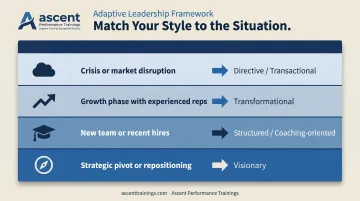
Match your style to the situation:
| Context | Recommended Style |
|---|---|
| Crisis or market disruption | More directive / transactional |
| Growth phase with experienced reps | Transformational |
| New team or recent hires | More structured / coaching-oriented |
| Strategic pivot or repositioning | Visionary |
A Self-Assessment Worth Running
Before assuming your current style fits, ask:
- What does my team need most right now — structure and clarity, inspiration and purpose, or development and coaching?
- How do I behave when a quarter goes badly? Does the team feel supported or blamed?
- How often do reps bring me real problems vs. curated good news? The answer reveals how psychologically safe they feel.
- Am I providing the coaching my managers need, or just holding them accountable for numbers?
Your answers point directly to where your leadership style needs to shift. Small, consistent changes in how you communicate expectations, recognize contributions, and handle underperformance compound over time — shaping the behavioral norms your team operates within. Get those norms right, and performance follows. Get them wrong, and your best reps start looking elsewhere.
Building the Leadership Skills That Drive Sales Excellence
Adaptive leadership is a learnable skill set, not a fixed personality trait. The executives who consistently develop high-performing teams aren't just naturally better — they've invested in structured development, not just accumulated years of management experience.
Tim Carlisle's upcoming book PERFORM Leadership offers a practical framework rooted in more than three decades of real-world sales leadership across multiple industries and global markets. It's designed to help leaders translate internal clarity into external, measurable impact — a critical link in sales environments where leadership behavior shows up directly in revenue numbers.
Ascent Performance Trainings' Sales Leadership Development program gives executives a structured path built on 30+ years of global expertise across 75+ countries. The intensive two-day in-person format (with a separate 10-week Ascent Leadership Academy option) focuses on practical application from day one:
- Identifies your default leadership style through DISC and EQ assessments
- Builds coaching skills that transfer directly to team performance conversations
- Develops the performance culture that sustains results quarter over quarter
- Includes eight weeks of post-training reinforcement — weekly coaching and video touchpoints — so behavioral change actually sticks
Frequently Asked Questions
What leadership style is most effective for sales teams?
There is no single best style. Transformational leadership tends to produce the strongest long-term engagement and retention, but effective executives adapt based on team maturity, market conditions, and organizational stage. The most resilient sales organizations are led by executives who flex, not default.
How does executive behavior affect sales team morale?
Executives set the cultural tone through how they respond to missed targets, credit the team, and back up reps in internal conversations. Reps are highly attuned to these signals — consistent fairness and transparency build psychological safety, while blame and dismissiveness erode it fast.
What is the difference between transformational and transactional leadership in sales?
Transformational leaders develop and inspire reps toward long-term growth and purpose. Transactional leaders drive performance through target-reward systems. Both have a place, but over-reliance on transactional approaches tends to reduce intrinsic motivation and increase attrition when better offers appear.
How does executive-level leadership differ from manager-level leadership in its sales impact?
Executive leadership shapes culture, strategic alignment, and long-term performance trajectory — manager-level leadership drives daily results through coaching and real-time guidance. Both levels must be aligned, because even a strong culture from the top can't compensate for a broken manager relationship on the ground.
What are the warning signs that a leadership style is hurting sales performance?
Watch for:
- Rising voluntary turnover among top performers
- Declining pipeline transparency — reps only share good news
- Inconsistent results with no clear external cause
- A team culture where reps won't flag risks or ask for help
Can an executive change their leadership style?
Yes — with intentional effort, structured reflection, and the right development support. The most effective sales leaders evolved their approach through coaching, feedback, and formal training, not by relying on good intentions alone.