Introduction
Customer service quality isn't just an operational concern — it's a direct revenue driver. According to Microsoft's 2017 State of Global Customer Service Report, 56% of global respondents had stopped doing business with a brand because of poor customer service — and nearly half of those walked away within the previous 12 months alone.
The business case is clear. For most organizations, the harder question is execution.
Most customer service teams know quality matters. The gap is structural: without a repeatable approach, service becomes inconsistent — excellent one day, frustrating the next, entirely dependent on which agent picks up the phone.
This guide covers the strategies that close that gap. From setting measurable standards and training your team, to building feedback loops and embedding a culture of great service — these are practical approaches organizations can act on now.
TL;DR
- Deep customer understanding — not assumptions — is the foundation every other strategy builds on.
- Effective training covers both technical and human skills, reinforced continuously — not delivered once and forgotten.
- Capture, analyze, and act on feedback systematically — or it generates no improvement at all.
- Clear KPIs and regular performance reviews create accountability and drive consistent quality.
- Culture and recognition determine whether service standards hold — or gradually fade without reinforcement.
Why Customer Service Quality Is a Business Imperative
A Bain & Company analysis found that a 5% increase in customer retention can increase profits by 25% to 95%. According to HBR, acquiring a new customer costs 5 to 25 times more than retaining an existing one. Put together, those two figures reframe customer service from a cost center into one of the highest-return investments a business can make.
The Word-of-Mouth Multiplier
Poor service doesn't stay between you and the customer. Research has consistently found that customers share bad experiences with significantly more people than positive ones — and in the era of online reviews, that word-of-mouth is permanent. A single unresolved complaint can reach an audience your marketing budget never anticipated.
What Quality Service Produces
Beyond retention, strong service quality links directly to measurable outcomes:
- Loyal customers buy more frequently, increasing lifetime value
- Satisfied customers don't shop competitors, reducing churn
- Exceptional experiences command up to a 16% price premium, per PwC's research
- Promoters actively refer new business, lowering acquisition costs
Each of these outcomes compounds. Better retention funds the investment in better training, which drives higher satisfaction scores, which feeds referrals — and the cycle builds from there.
Know Your Customer: Understanding Needs and Setting Clear Standards
Good service starts with accurate information — not guesses about what customers want.
Building a Real Picture of Customer Needs
Use every available data source to understand what customers actually experience:
- Post-interaction surveys to capture satisfaction at the moment it's freshest
- CRM data to identify recurring issues, common requests, and high-friction touchpoints
- Frontline team input — agents hear patterns that no survey captures
- Complaint logs to find what's breaking down most consistently
The goal is to surface what customers genuinely need — not what the business assumes they need, which is frequently a gap worth closing.
Setting Standards That Teams Can Actually Execute
Without documented standards, service quality varies with whoever happens to be on shift. Every customer service team should have clearly defined expectations covering:
- Response time by channel (email, phone, chat)
- Tone of communication and escalation language
- Escalation paths and ownership at each stage
- Resolution timelines and follow-up protocols
If a new team member can't read your standards and know exactly what "good" looks like, they're not specific enough.
Map the Customer Journey
Standards tell your team how to behave — journey mapping shows you where those standards matter most. Walk every touchpoint a customer experiences (initial inquiry, purchase, onboarding, post-sale support) and identify where friction accumulates. Journey mapping often surfaces gaps that internal teams have normalized but customers actively resent.
Proactive Service vs. Reactive Service
Most teams default to reactive service: respond when something breaks. Proactive service flips that equation — anticipating needs before customers have to raise them.
Practical examples include:
- Follow-up calls 48 hours after a purchase to confirm satisfaction
- Automated reminders ahead of renewal or contract deadlines
- Outreach on any issue that's been open beyond the expected resolution window
Proactive service reduces complaint volume, but the bigger payoff is trust. Customers who feel anticipated — not just responded to — stay longer and require less effort to retain.
Train and Empower Your Customer Service Team
Service quality is ultimately a people issue. Technology and processes support it, but they don't create it.
What Effective Training Must Cover
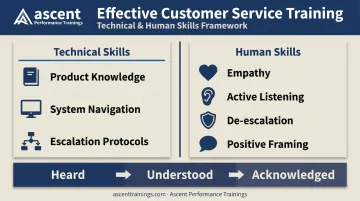
Customer service training has two dimensions that both require attention:
Technical skills:
- Product and service knowledge
- System navigation and tooling
- Process adherence and escalation protocols
Human skills:
- Empathy and perspective-taking
- Active listening and validation
- De-escalation and emotional regulation
- Positive language framing ("here's what I can do" rather than "I can't do that")
HBR research found that when employees genuinely understand the people they're serving, they solve problems more creatively and deliver better service. Empathy, in other words, is as operationally important as any technical capability.
A specific technique worth building into training is the heard-understood-acknowledged model: before moving to any solution, agents explicitly validate the customer's frustration. This single step reduces escalations and improves satisfaction, because most customers want to feel heard before they want to be helped.
Why One-Time Training Doesn't Work
ATD research cites the Ebbinghaus forgetting curve — without reinforcement, people forget most of what they learn within days. A single workshop, however well-designed, doesn't produce lasting behavior change.
The evidence supports spaced reinforcement: learning distributed across time, with regular practice and feedback, produces significantly better retention than front-loaded training events.
Ongoing Coaching as a Performance Driver
The shift from a feedback model to a coaching model is where team leaders have their biggest impact. Feedback tells agents what they did wrong. Coaching guides them to discover improvements themselves — which produces higher ownership and more durable change.
The Ascent Customer Service Academy, for example, is a 10-week program that builds communication, problem-solving, emotional intelligence, and relationship-building skills. It's followed by 8 weeks of post-training support — weekly coaching videos and monthly one-on-one sessions — so the skills agents practice in training are the ones that show up in real customer interactions.
Build a Continuous Feedback and Improvement Loop
Most organizations collect feedback. Far fewer build a system that acts on it consistently — and that gap is where customer service quality stalls.
Key Feedback Channels
Cover multiple sources to avoid blind spots:
- Post-interaction CSAT surveys — immediate satisfaction capture
- NPS surveys — periodic loyalty and advocacy measurement
- Online reviews — unfiltered public sentiment
- Complaint logs — systematic tracking of recurring failures
- Agent observations — qualitative insight from the frontline
Each channel surfaces a different dimension of the customer experience. Relying on only one creates gaps.
From Data to Root Causes
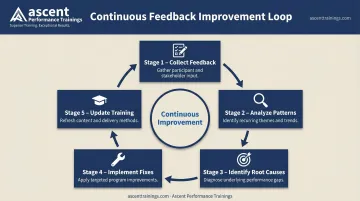
The purpose of feedback analysis isn't to count complaints — it's to find patterns. Ask:
- Which issues recur most frequently?
- Which touchpoints generate the most friction?
- Are problems caused by people, processes, or policies?
Root-cause analysis matters because surface-level fixes don't hold. If agents consistently struggle with difficult conversations, the fix isn't a memo — it's targeted coaching on de-escalation.
Closing the Feedback Loop
Feedback only builds trust when customers see it used. Share improvements with the team, make visible changes based on patterns, and where relevant, communicate those changes back to customers. That visible responsiveness is what converts one-time customers into long-term advocates.
Connect feedback findings directly to training priorities. A pattern in complaint data revealing a skills gap should become the input for the next coaching cycle, creating a cycle where better data continuously drives better training.
Foster a Customer-Centric Culture and Recognize What Works
Service standards don't sustain themselves — culture either reinforces them or lets them drift.
Leadership Sets the Standard
Leaders who talk about customer-first values but model different behaviors in practice send a clear message — and teams respond to actions, not words. Practical steps that make culture visible:
- Team huddles that open with customer wins, not just metrics
- Transparent sharing of CSAT results across the team
- Leaders personally acknowledging excellent service moments
Recognition That Actually Motivates
Recognition programs tied to specific customer service behaviors — not just output metrics — have a measurable effect on how consistently those behaviors appear. The mechanism is straightforward: people repeat what gets noticed.
Recognition doesn't require a budget. Peer nominations, public acknowledgment in team meetings, and small team rewards are often more meaningful than cash bonuses because they're personal and visible.
The Engagement-Service Connection
Engaged teams produce better customer outcomes — and the data backs this up. Gallup's Q12 Meta-Analysis found that top-quartile business units have 10% higher customer loyalty and engagement and 23% higher profitability than bottom-quartile units. Engaged employees deliver better service not because they're told to, but because they care about the outcome.
Team wellbeing, clear role expectations, and a supportive environment are direct inputs to service quality — not separate HR concerns.
Measure What Matters: Key Metrics and Performance Reviews
You can't improve what you don't measure — but you also need to measure the right things.
The Core Customer Service KPIs
| Metric | What It Measures | Why It Matters |
|---|---|---|
| CSAT | Customer satisfaction after an interaction | Primary outcome metric for service quality |
| First Contact Resolution (FCR) | % of issues resolved on first interaction | ICMI identifies this as the single strongest predictor of customer satisfaction |
| Average Resolution Time (ART) | Time from first contact to resolution | Tracks efficiency; pair with CSAT to avoid rewarding speed over quality |
| Net Promoter Score (NPS) | Customer likelihood to recommend | Loyalty and advocacy indicator |
| Reopen Rate | % of resolved cases that customers reopen | Quality control; guards against false resolution |
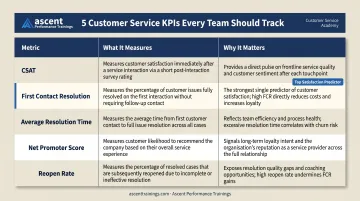
FCR deserves particular attention. ICMI's research shows high FCR is consistently linked to high customer satisfaction — making it the clearest operational lever available to service teams.
Turning Metrics Into Action
Metrics without review cadences are just numbers. Structure your reviews to match the decision they need to drive:
- Run daily or weekly team check-ins to catch and correct emerging issues in real time
- Hold monthly one-on-ones for individual development and targeted coaching
- Use quarterly strategy reviews to assess whether systemic changes are warranted
Sharing metrics transparently with the team matters. Agents who can see their own numbers take greater ownership of their performance, and coaching lands better when the data speaks for itself rather than feeling like a personal critique.
Frequently Asked Questions
Frequently Asked Questions
How do you improve customer service quality?
Start with a clear picture of what customers actually need, then set documented service standards your team can execute consistently. Layer in targeted training on both skills and mindset, establish a feedback loop that turns customer data into coaching priorities, and track FCR and CSAT to measure progress over time.
What are the 7 C's of quality customer service?
The 7 C's — Communication, Competence, Courtesy, Credibility, Consistency, Customer Focus, and Care — serve as a practical mnemonic for service quality priorities. Each element points to a genuine capability that customer service teams need to develop and reinforce over time.
What are the 4 P's that improve customer service?
The 4 P's — Promptness, Politeness, Professionalism, and Personalization — function as a quick behavioral guide for agent interactions. They're most useful as a shorthand during training and coaching sessions, not as a formal measurement standard.
What is the 10-5-3 rule in customer service?
The 10-5-3 rule originates in hospitality: acknowledge customers at 10 feet, make eye contact and smile at 5 feet, and greet verbally within 3 feet. It applies to in-person customer interactions. For organizations with physical customer touchpoints, it provides a simple, trainable standard for creating warm first impressions.
What are the most important skills for customer service excellence?
Empathy, active listening, clear communication, problem-solving, and product knowledge form the core. All five are trainable, but they require ongoing reinforcement through role-play, coaching, and regular feedback — not a single training event.