How an agent listens, responds under pressure, or communicates bad news often matters more to the customer than whether the problem technically got solved. According to PwC's research across 15,000 consumers in 12 countries, 32% of customers would stop doing business with a brand they loved after just one bad experience. One interaction. One agent who missed the moment.
Most organizations acknowledge soft skills matter. Far fewer have a reliable method for actually improving them. This guide covers which skills to prioritize, a five-step method for building them, and the variables that determine whether your program produces real behavior change — or just a training certificate.
TL;DR
- Active listening, empathy, communication clarity, and emotional resilience drive customer satisfaction and retention
- Improvement starts with diagnosing observable gaps in real interactions, not assumptions about which traits need work
- One-time workshops don't change behavior; spaced practice, coaching, and reinforcement do
- Manager involvement between sessions is what determines whether training actually sticks
- Measure improvement through CSAT trends, escalation rates, and call review scores tied to a behavioral rubric
Why Soft Skills Are the Deciding Factor in Customer Service Quality
Customers contact support when something has already gone wrong. That means every interaction carries emotional weight from the start — frustration, inconvenience, real financial or personal impact. The agent's technical ability to resolve the issue matters, but how they handle the emotional dimension of the call determines whether the customer feels helped or dismissed.
The stakes are rising, not shrinking. Forrester noted in 2024 that AI is taking over repetitive, predictable service tasks — freeing (and redirecting) human agents toward the complex, emotionally charged interactions that automation can't handle. Empathy, judgment, and communication clarity aren't soft add-ons to the job description anymore. They're the job.
That shift onto human agents carries a cost beyond customer satisfaction. Research using the Job Demands-Resources model found that emotional dissonance in call centers is directly linked to burnout and turnover intentions. Agents who can regulate their emotional responses under pressure don't just serve customers better — they stay longer and burn out less.
For service leaders, that makes soft skill gaps a triple threat — to customer experience, to revenue, and to team retention.
The Core Soft Skills Every Customer Service Team Must Build
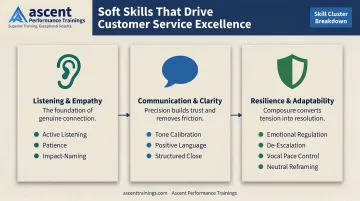
Effective customer service soft skills cluster into three interconnected areas. They're not isolated traits — they compound on each other. An agent who listens well communicates more clearly. An agent who regulates their emotions holds up better under conflict. Each cluster below maps to observable, coachable behaviors — not vague personality traits.
Listening and Empathy
This cluster includes active listening, patience under repetition, and a technique called impact-naming — explicitly acknowledging the effect a problem had on the customer before moving to a solution.
What it looks like as an observable behavior: Before proposing a fix, the agent says something like, "It sounds like this delay has put you in a tough spot with your client — let me make sure I understand what happened." That's coachable. "Be empathetic" is not.
Communication and Clarity
This covers clear verbal and written expression, tone calibration, and consistent use of positive language. The goal isn't just being polite — it's ensuring the customer understands what's happening and what comes next.
Observable behavior example: After resolving an issue, the agent summarizes the outcome and confirms the customer's next step rather than ending the call abruptly. That structured close also reduces callbacks — customers who know their next step don't need to call back to ask.
Resilience and Adaptability
Emotional self-regulation under load, de-escalation during conflict, and flexibility when processes shift mid-interaction. This is the cluster most often missing from training programs — and most often responsible for escalations.
Trainable behaviors in this cluster include:
- Lowering vocal pace and tone when a customer becomes aggressive, rather than matching their energy
- Using neutral language to reframe complaints ("I want to make sure we get this right for you")
- Pausing before responding during high-tension moments instead of reacting immediately
- Acknowledging process changes without expressing frustration in front of the customer
How to Improve Soft Skills in Customer Service Teams
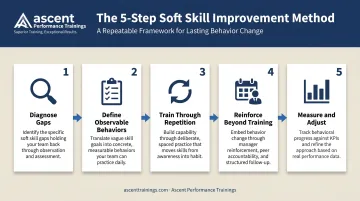
Step 1: Diagnose Current Gaps Before Training Begins
Don't assume you know where the gaps are. Pull recorded calls or chat transcripts and flag specific behavioral breakdowns:
- Agent interrupted before the customer finished their explanation
- Apology was generic ("I'm sorry for the inconvenience") rather than specific to what happened
- Tone shifted audibly when the interaction became difficult
- No summary of the resolution before closing the ticket
Pair that internal observation with external signals: CSAT scores, complaint patterns, and escalation frequency all point to where soft skill gaps are concentrating — at a team level and for individual agents.
Step 2: Define What "Good" Looks Like in Observable, Behavioral Terms
Vague goals produce no behavior change. "Be more empathetic" gives an agent nothing to practice. Managers need to translate each target skill into a specific, demonstrable action.
| Vague Goal | Observable Behavior |
|---|---|
| Show understanding | Summarize the customer's concern before proposing a solution |
| Be patient | Let the customer finish speaking before responding — no interruptions |
| Communicate clearly | State the resolution and next steps in plain language before ending the call |
| Handle conflict better | Lower vocal pace when a customer escalates tone |
Building a simple behavioral rubric gives agents a concrete target and gives managers a consistent coaching standard. This is the step most teams skip — and it's why feedback often feels arbitrary.
Step 3: Use Training Methods That Build Habits Through Repetition
The most effective soft skill development methods simulate real interactions, then provide feedback on what happened. That means:
- Structured role-play scenarios — agents respond to realistic interaction types, not hypothetical abstractions
- Peer feedback sessions using recorded calls or chat transcripts
- Call calibration meetings where managers and team leads score the same interaction together
- Scenario-based group discussions that surface how different agents would handle the same situation
Lecture-based training transfers knowledge. It doesn't build instinct. The difference is repetition in context.
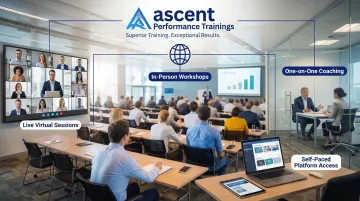
Multi-modal delivery matters here too. Combining in-person sessions, live virtual practice, and one-on-one coaching creates multiple reinforcement touchpoints rather than a single-format exposure.
Ascent Performance Trainings structures its customer service training around exactly this approach — in-person workshops, live Zoom micro-learnings, one-on-one coaching, and a 24/7 self-paced platform delivered across 75+ countries. The goal is behavioral change that sticks, not a one-time knowledge transfer.
Step 4: Reinforce Soft Skills Beyond the Training Room
Most programs stop at the workshop. Without deliberate reinforcement in the weeks that follow, trained behaviors revert — and the investment disappears with them.
Managers should build in:
- Brief weekly check-ins focused on one target behavior
- Real-time feedback when they observe a specific skill being applied — or missed
- Positive recognition when an agent demonstrates a trained behavior under pressure
Ascent Performance Trainings' post-program model addresses this directly: eight weeks of weekly video reinforcement paired with monthly coaching sessions ensure that what was trained in the program gets applied, practiced, and embedded back on the floor. As one Chief Revenue Officer noted after completing the program: "Most programs leave you after the workshop, but Ascent Performance ensured our team had the reinforcement and coaching needed to sustain long-term success."
Step 5: Measure Improvement and Adjust
If you can't see whether behavior is changing, you can't course-correct. Track improvement through:
- CSAT and NPS trend data — especially for individual agents over time
- First-contact resolution rates — agents with stronger soft skills tend to resolve issues without transfers or callbacks
- Escalation frequency — declining escalations often signal improving conflict handling
- Call or chat review scores tied to the behavioral rubric from Step 2
ATD research found that only 45% of organizations have a dedicated person responsible for evaluating learning programs. That gap is a significant reason why training investments go unvalidated — and why programs that aren't working go uncorrected.
Periodic calibration reviews — where managers score the same recorded interaction independently and then compare — help maintain scoring consistency and surface new coaching priorities as the team improves.
Key Variables That Determine Whether Soft Skills Training Actually Works
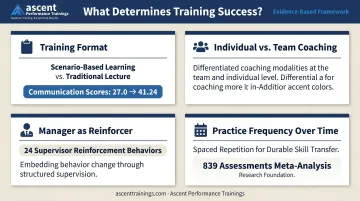
Two organizations can run nearly identical training programs and see completely different results. Outcomes depend on a set of controllable variables that most teams underinvest in.
Training Format
Lecture-style or one-day workshops generate awareness. They rarely generate behavior change. The formats that produce measurable improvement share one characteristic: agents practice responding to realistic scenarios, receive immediate feedback, and repeat the behavior until it becomes instinctive. A 2024 study on scenario-based role-play found that communication scores improved from 27.0 to 41.24 across structured encounters with feedback — a near-doubling through repeated, guided practice.
Individual vs. Team-Level Coaching
Every agent has a different soft skill profile. One agent may listen attentively but shut down emotionally when a call escalates. Another may be warm and personable but struggle to communicate resolutions clearly. Generic group training misses both. A 2023 workplace coaching meta-analysis confirmed that individualized coaching produces positive organizational outcomes beyond what group training alone achieves. Group training sets the standard — one-on-one coaching is what actually closes individual gaps.
Manager as Reinforcer
The single biggest predictor of whether training behavior transfers to the job is whether managers reinforce it between sessions. Research reviewing 99 articles identified 24 distinct supervisor behaviors that influence training transfer — from providing feedback after observed interactions to modeling target behaviors themselves. Teams where managers acknowledge skills applied in real interactions see significantly higher transfer.
Practice Frequency Over Time
Soft skills don't stick from a single exposure. A large meta-analysis synthesizing 839 assessments from 317 experiments found that spaced repetition supports retention far more effectively than cramming skills into a single session. One skill practiced weekly against a real interaction produces more durable change than a comprehensive half-day workshop once a quarter.
Common Mistakes When Developing Soft Skills in Customer Service Teams
Running a single session and returning to business as usual is the most common failure. Soft skills require repeated reinforcement — without follow-up, trained behaviors typically regress within weeks.
Telling agents to "be patient" or "show empathy" without defining what that looks like in a real interaction gives them nothing to practice. Effective training specifies observable actions — and examples of what not to say.
Applying identical training to every agent — regardless of skill level — wastes time on strengths and misses actual gaps. Coaching based on observed performance is far more effective than blanket programs.
Skipping measurement entirely leaves managers guessing. Without call reviews, CSAT tracking, or rubric-based scoring, there's no way to confirm agents are applying what they learned — or which skills still need work.
Frequently Asked Questions
What are the soft skills needed in customer service?
The core clusters are active listening, empathy, clear communication, patience, emotional self-regulation, adaptability, and conflict de-escalation. What makes them trainable is defining each as observable, repeatable behaviors rather than personality traits — that's what makes practice and coaching actually stick.
What are the 5 C's of soft skills?
The framework covers Communication, Collaboration, Critical Thinking, and Creativity, with some versions adding Character or Conscientiousness as a fifth. In customer service, all five show up: communication and collaboration drive most interactions, while critical thinking shapes how agents handle anything outside the standard playbook.
What are the 5 P's of customer service?
One widely used version includes Patience, Presence, Preparation, Professionalism, and Positivity. Each maps to a trainable behavior: Patience to emotional regulation, Presence to active listening, Positivity to tone and language.
What is the 10/5/3 rule in customer service?
The 10/5/3 rule is a behavioral standard from hospitality that calls for acknowledging a customer at 10 feet, greeting them at 5 feet, and responding within 3 seconds. It's a practical example of how abstract service principles get converted into specific, coachable behaviors — exactly the kind of specificity that makes soft skill training work.
Can soft skills actually be taught, or are they innate personality traits?
Specific soft-skill behaviors are trainable — research on behavior modeling, role-play, and spaced practice confirms this consistently. Personality-based advice doesn't move the needle; defining observable behaviors and practicing them with structured feedback does.
How do you measure soft skill improvement in a customer service team?
Track CSAT and NPS trend data over time, monitor escalation frequency, score call and chat reviews against a behavioral rubric, and watch first-contact resolution rates. Regular calibration sessions, where managers score the same interaction independently and then compare results, help maintain consistent standards and surface new coaching priorities.