The best sales organizations don't fix this with a one-time training event. They build cultures of continuous mentorship and coaching — where skill development happens in the flow of real work, not just in a conference room once a year.
According to Salesforce's 2024 State of Sales report, 67% of sales reps didn't expect to meet quota, and reps spent 70% of their time on non-selling tasks. That's not a product knowledge problem. It's a focus, behavior, and development problem — exactly what strong coaching and mentorship are designed to solve.
This article covers the qualities, strategies, and structures that define genuinely effective sales mentors and coaches, including how to measure whether it's working.
TL;DR
- Coaching is short-term and performance-focused; mentoring is long-term and career-focused — top sales leaders do both well.
- Build psychological safety first — skill transfer falls flat without it.
- Consistent cadence, live-deal coaching, and targeted questioning beat ad hoc advice every time.
- Strong mentorship programs succeed through deliberate pairing, phased milestones, and a clear graduation point.
- Measure both hard metrics (quota, win rate, ramp time) and behavioral signals (confidence, peer-sharing, stretch assignments).
Sales Mentor vs. Sales Coach: Understanding Both Roles
These two roles get used interchangeably, but they serve different purposes — and confusing them is one reason so many development programs underdeliver.
What Sets Them Apart
| Dimension | Sales Coach | Sales Mentor |
|---|---|---|
| Time horizon | Short to medium term | Long term (months to years) |
| Primary focus | Specific skill gaps, pipeline execution, call quality | Career trajectory, confidence, organizational navigation |
| Who fills the role | Direct manager or team lead | Senior colleague outside direct chain |
| Measured by | Win rate, quota attainment, behavior change | Growth over time, career progression, retention |
| Conversation tone | Structured feedback with action steps | Candid, reflective, advisory |
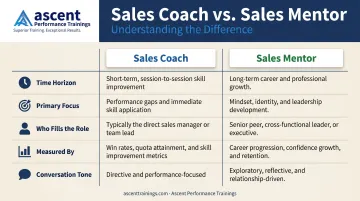
The table above reflects a real structural difference. As ATD notes, coaching is a thought-provoking process to maximize performance, while mentoring is a longer-term relationship focused on career movement. Treating them as the same role means doing neither well.
Why Both Are Necessary
A coach without a mentor leaves reps technically sharp but career-directionless. A mentor without a coach leaves reps inspired but stuck on the same deal mistakes every quarter.
Coaching drives results now. Mentoring builds the rep who delivers results a year from now. The strongest sales organizations run both tracks in parallel — because one without the other leaves a gap that eventually shows up in attrition or a stalled pipeline.
Avoid pairing reps with their direct manager for mentorship. The power dynamic limits candor, and reps are less likely to admit career doubts or skill gaps to someone who writes their performance review.
Core Qualities of an Effective Sales Mentor and Coach
The Mentor Mindset
Empathy comes first. Sales is hard — rejection is constant, pressure is relentless, and uncertainty is the baseline. Mentors who've lived that experience and remember what it felt like create genuine trust. Those who've forgotten (or never acknowledged it) tend to offer advice that sounds right but doesn't land.
The practical expression of empathy in mentoring isn't sympathy — it's listening without immediately jumping to solutions. When a rep describes a deal that went sideways, the instinct is to explain what they should have done. The better move is asking what they think went wrong, then listening fully before responding.
Psychological safety isn't optional. Reps will only be honest about where they're struggling when they feel no fear of judgment or reprisal. HBR defines psychological safety as a shared belief that a team is safe for interpersonal risk-taking — including speaking up about mistakes and gaps. Mentors set this tone from the first conversation, often by sharing their own early-career failures before asking about anyone else's.
The Coach's Toolkit
Effective coaching hinges on two things: feedback that changes behavior, and guidance that fits the rep in front of you.
On feedback, specificity is everything. Observations tied to observable actions give reps something to act on:
- Works: "Your discovery questions led the buyer to talk about price too early — here's what to try instead"
- Doesn't work: "You're not building enough rapport" (no actionable direction)
Adapting by experience level is where many coaches fall short. A first-year rep needs directive guidance — clear frameworks, structured call templates, explicit next steps. A seasoned rep who's been closing for a decade often responds better to questions than answers. Ask them to self-assess. Most already know what went wrong — they just need space to say it out loud.
This is the foundation of Ascent Performance Trainings' 1:1 coaching model — built on Tim Carlisle's 30+ years of experience across 75 countries. Each session is structured around the individual's specific strengths, growth areas, and goals, not a one-size-fits-all framework.
Practical Strategies for Effective Sales Coaching
Build a Consistent Cadence
Coaching that happens "when there's time" doesn't compound. CSO Insights found that dynamic coaching produced a 55.2% win rate — 13.4 points above organizations using random or informal coaching. The difference isn't talent; it's structure.
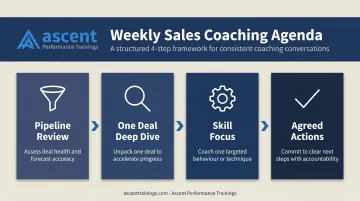
A reliable weekly one-on-one format works well with this agenda:
- Pipeline review — identify deals at risk and why
- One specific deal or challenge — go deep rather than broad
- Skill focus — connect a behavior gap to what's happening in that deal
- Agreed actions — what changes before the next session
Monthly, zoom out to assess progress on bigger skill and career goals.
Coach to Real Deals, Not Simulations
The most memorable coaching happens on live pipeline. Walk a rep through a stalled deal — ask them to narrate their approach, explain where momentum broke down, and identify what they'd do differently. That process surfaces blind spots that scripted scenarios simply can't expose.
Role-plays still have value for practicing new techniques in a safe environment. The key is pairing that practice with real-deal analysis — one reinforces the other.
Ask More Than You Tell
The Socratic approach — questions over prescriptions — builds self-awareness that outlasts any single coaching session. Try:
- "What do you think went wrong on that call?"
- "What would you do differently if you had that conversation again?"
- "What's the buyer's actual decision-making process — do we know it?"
Reps who develop this habit of self-diagnosis start catching their own mistakes before the next call — which is where real performance gains compound.
Separate Coaching from Performance Reviews
When reps fear that admitting a deal is stalled will trigger a performance warning, they stop being honest in coaching sessions. Keep coaching conversations clearly separate from formal evaluations. One practical way: open each session by explicitly framing it as a development conversation, not an assessment.
How to Structure a Sales Mentorship Program That Works
Start with Intentional Matching and Clear Goals
Define what the program is for before matching anyone. Faster ramp time, retention, leadership pipeline development — different goals require different mentor profiles and different session structures.
Match by skill gaps and career goals, not by convenience or seniority alone. A rep who wants to move into sales leadership needs a mentor who has navigated that transition, not necessarily the most technically skilled closer on the team.
Build a Phased Playbook
Vague mentoring relationships drift. A structured guide prevents this:
- Days 1–30: Orientation, trust-building, identifying top 2–3 development priorities
- Days 31–60: Focused skill work on priority areas, exposure to stretch situations
- Days 61–90: Independent application, peer knowledge-sharing, preparation for graduation milestone
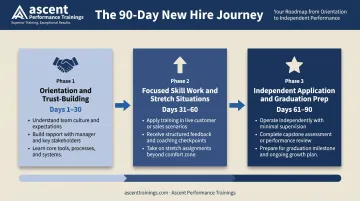
Define what "good progress" looks like at each stage so neither side is guessing.
Define a Graduation Point
Without an exit strategy, mentees never fully step into their own confidence. A defined graduation moment — leading a team presentation, independently closing a target deal, presenting a territory plan — signals that the mentee has internalized the development, not just received it.
Ascent Performance Trainings builds this into its Academy programs through the proprietary Ascent Performance Training Certificate — a credential that marks genuine completion, not just attendance.
Blend Individual and Group Formats
One-on-one sessions provide depth and personalization. Group mentoring — small cohorts with a single mentor — surfaces shared challenges, builds team cohesion, and multiplies the mentor's impact without thinning it out.
Individual sessions are where candid, high-stakes conversations happen. Group sessions are where collective problem-solving takes root. Strong programs build in both intentionally.
Reinforce Learning Beyond Formal Sessions
Development that stops when the formal program ends doesn't stick. Research suggests it takes roughly 66 days for a new skill to become a habit, which means a training event without follow-up reinforcement is a wasted investment.
Ascent Performance Trainings addresses this directly through 8 weeks of post-training reinforcement:
- Weekly videos with key topic reminders for daily application
- Monthly 1:1 coaching sessions where participants work through individual challenges and get tailored feedback
The design ensures skills transfer to real work — not just the training room.
How to Measure Your Impact as a Mentor and Coach
Quantitative Metrics to Track
| Metric | What It Tells You |
|---|---|
| Quota attainment trend | Whether coached reps close more over time |
| Win rate (forecast deals) | Quality of opportunity execution |
| Ramp-to-first-deal | Whether onboarding support is reducing time-to-contribution |
| Pipeline velocity | Whether deals are moving faster and more predictably |
| Coaching coverage | Are all reps receiving consistent sessions, not just struggling ones? |
According to the Sales Management Association, high-performing firms provide 15–20% more coaching than lower-performing peers. The gap isn't just volume — it's consistency across rep segments, not only concentrated on the lowest performers.
Qualitative Behavioral Signals
Metrics tell part of the story. Numbers lag — behavioral signals often appear weeks before quota movement:
- A rep stops waiting to be told what to do and starts proposing their own approaches
- Someone begins sharing strategies with peers rather than hoarding them
- A rep volunteers for a stretch assignment they'd previously avoided
- Questions shift from "what should I do?" to "here's what I'm thinking — what am I missing?"

These shifts are early indicators that coaching and mentoring are working. Track them deliberately.
Feedback Loops and Program Iteration
Run brief periodic check-ins with mentors and mentees — a short conversation or survey covering whether sessions feel useful, whether the pairing is working, and what could improve. Use that input to refine matching, session formats, or focus areas.
The best programs treat their initial design as a starting point, not a fixed blueprint. Small adjustments made mid-cycle often produce faster results than waiting for a full program review.
Frequently Asked Questions
What is the difference between a sales coach and a sales mentor?
A sales coach focuses on near-term performance — improving specific skills, working through current deals, and closing behavioral gaps tied to this quarter's targets. A sales mentor focuses on long-term development — career navigation, confidence, and professional growth over months or years. Effective sales leaders learn to practice both.
What are the key C's of sales coaching and mentorship?
The commonly referenced framework covers five areas: Clarity, Consistency, Communication, Commitment, and Confidence. Together, they shift coaching and mentorship from reactive, ad hoc interactions to a structured system that builds sustainable habits over time.
How do you measure the success of a sales mentorship program?
Track both quantitative outcomes — quota attainment, win rates, ramp time, retention — and qualitative behavioral signals like increased rep confidence, peer knowledge-sharing, and willingness to take on stretch assignments. The numbers tell you what happened; the behavioral signals tell you what's coming.
How often should a sales mentor or coach meet with team members?
For performance coaching, weekly one-on-one sessions provide enough frequency to address pipeline and skill issues before they compound. For mentorship, monthly structured sessions with informal check-ins in between work well. Consistency matters more than frequency — irregular sessions don't build momentum.
What qualities make someone an effective sales mentor or coach?
The core qualities are empathy, active listening, the ability to give honest feedback without making it personal, and adaptability to different learning styles. Above all, the best mentors and coaches care more about the rep's success than about being seen as the expert — and that shows.
How much does a sales coaching or mentorship program cost?
ATD's research puts the median organizational spend at $1,000–$1,499 per salesperson on sales training annually. Costs vary by format, scope, and whether you're using internal resources or external providers. Programs with structured post-training reinforcement tend to deliver better results than lower-cost options with no follow-through.