Introduction
The terms "executive coaching" and "leadership coaching" appear in L&D conversations, talent strategy decks, and HR budgets — often used as though they mean the same thing. They don't.
Using them interchangeably isn't just imprecise — it has real consequences:
- A senior executive enrolled in a program built for first-line managers
- A high-potential team lead placed in coaching that assumes C-suite complexity
- An organization investing heavily in the wrong development approach entirely
The wrong coaching fit means wasted budget and minimal behavior change. The right one accelerates performance at the exact level where it's needed.
This article breaks down both coaching types clearly — what each one is, where it works, and how to make the right call based on your role, your goals, and what your organization actually needs.
TL;DR
- Executive coaching targets senior leaders (C-suite, VPs) on strategic performance, organizational influence, and high-stakes decision-making.
- Leadership coaching builds capability in managers, team leads, and high-potentials — covering self-awareness, communication, and people leadership skills.
- Both develop emotional intelligence and strategic thinking, with differences in audience, depth, and delivery approach.
- Your choice depends on current role, development gap, and whether you need depth for one leader or breadth across a team.
- Most organizations benefit from running both simultaneously — they reinforce each other at different levels.
What Is Executive Coaching?
Executive coaching is a highly personalized, one-on-one development process built for senior leaders (C-suite executives, VPs, and directors) who are already operating at a high level. The goal is to help capable leaders go further — not cover fundamentals they already know.
What Executive Coaching Addresses
The core focus areas are distinctly strategic:
- Decision-making under pressure — navigating high-stakes, ambiguous choices with limited information
- Influencing boards, investors, cross-functional peers, and external partners
- Shaping how leadership behaviors cascade through the business
- Succession planning — preparing the executive and the organization for leadership transitions
Executives arrive with deep domain expertise already intact. The coach's role is to enable reflection — asking questions the executive rarely gets asked and creating structured space for honest thinking. That's where the most valuable insights tend to surface.
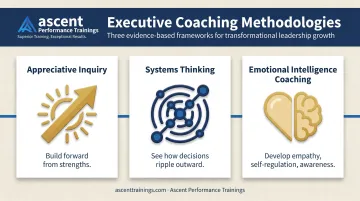
Common Methodologies
Executive coaches draw from a specific set of frameworks suited to high-level complexity:
- Appreciative Inquiry — building forward from strengths rather than diagnosing deficits
- Systems Thinking helps executives see how decisions ripple outward across the organization
- Emotional Intelligence Coaching — developing empathy, self-regulation, and interpersonal awareness at the top
Executives are high-performers with limited time and high expectations. A coach working at this level needs to earn trust quickly and deliver visible value. Drawn-out exercises and slow rapport-building don't survive long in a CEO's calendar.
When Executive Coaching Fits Best
Executive coaching is most valuable in these scenarios:
- A newly promoted CEO navigating their first 12 months
- A senior leader managing a major restructure or acquisition
- An executive with strong technical or commercial credentials but gaps in stakeholder communication
- A leader preparing for board presentations or succession
Research from Stanford GSB's 2025 CEO Coaching Survey confirms that executive coaching adoption continues to grow among top leaders. Adoption is highest in large enterprises, financial services, and high-growth technology companies — where a single leadership misstep can carry significant organizational cost.
What Is Leadership Coaching?
Leadership coaching serves a much broader population. It's designed to build leadership capability across multiple organizational levels — not just the executive suite. The target audience includes mid-level managers, team leads, emerging leaders, and high-potential individual contributors who exercise informal leadership without positional authority.
What Leadership Coaching Develops
Where executive coaching assumes existing capability and adds strategic depth, leadership coaching builds the foundation:
- How you show up as a leader — and how your team actually experiences you (self-awareness)
- Giving clear direction, handling difficult conversations, and motivating people across different working styles
- Managing your own reactions while staying attuned to what your team needs
- Letting go of doing the work yourself to focus on enabling others
- Addressing tension and conflict early, before it becomes dysfunction
The emphasis is behavioral. Leadership coaching is about developing a leadership identity, not just refining performance in an existing role.
Common Methodologies
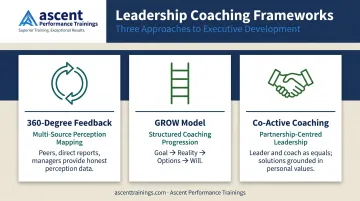
Three frameworks show up most often:
- 360-degree feedback assessments pull input from peers, direct reports, and managers — giving leaders an honest picture of how they're perceived, not just how they see themselves
- The GROW model (Goal, Reality, Options, Will) — a structured coaching conversation that moves from aspiration to action
- Co-Active Coaching pairs the coach and leader as equals, building solutions grounded in the leader's own values rather than prescribing a fixed playbook
Why Demand Has Grown
Leadership coaching has moved from a nice-to-have into a core L&D investment for a few converging reasons:
- Flatter organizational structures require more people to lead without formal authority
- Cross-generational teams demand more sophisticated interpersonal skills
- Gallup research shows managers account for 70% of the variance in employee engagement. That makes their development one of the highest-leverage investments an organization can make
- The rise of AI has made soft skills — empathy, communication, adaptability — more critical, not less
When Leadership Coaching Fits Best
Leadership coaching delivers the most impact in these situations:
- A manager stepping into their first people-leadership role
- A team leader struggling with delegation or conflict resolution
- An organization building leadership bench strength across multiple levels
- A high-potential employee being prepared for future leadership responsibility
- Organizations undergoing cultural change, where new leadership behaviors need to spread broadly
Executive Coaching vs. Leadership Coaching: Key Differences
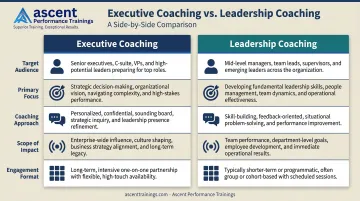
The contrast between these two coaching types becomes clearest when you look at them side by side.
| Dimension | Executive Coaching | Leadership Coaching |
|---|---|---|
| Target Audience | C-suite, senior VPs, directors | Managers, team leads, high-potentials |
| Primary Focus | Strategic performance, organizational influence | Skill-building, self-awareness, team effectiveness |
| Coaching Approach | Reflective, insight-driven, confidential | Behavioral development, structured frameworks |
| Scope of Impact | One individual at the top | Leadership capability across multiple levels |
| Engagement Format | Intensive 1:1, long-term | Group programs, workshops, hybrid formats |
Where the Overlap Lives
Both coaching types develop communication, emotional intelligence, and strategic thinking. The difference isn't what skills are being built — it's the level of complexity at which those skills are applied and the methodology used to develop them.
An executive working on communication is navigating board rooms, investor calls, and organizational narratives. A manager working on communication is running 1:1s, giving feedback, and facilitating team meetings. The skill category is identical — the context couldn't be more different.
How Organizational Culture Shapes the Choice
That context gap extends beyond the individual. How your organization is structured often determines which coaching type — or which combination — actually moves the needle:
- Traditional hierarchies benefit most from executive coaching concentrated at the top, where positional authority drives org-wide decisions
- Flat or distributed organizations gain more from broad leadership coaching programs, since decision-making is distributed and capability needs to scale with it
The two approaches aren't mutually exclusive. Many high-performing organizations run both simultaneously: executive coaching for the C-suite, structured leadership development programs for managers and high-potentials. That combination creates a connected development strategy rather than a series of one-off programs.
How to Choose the Right Coaching for Your Goals
The right answer comes down to three variables: your role, your gap, and your scope (individual or organizational).
A Practical Decision Framework
Choose executive coaching if:
- You're a senior executive dealing with board dynamics, succession, or organizational restructuring
- You need a confidential sounding board for high-stakes strategic decisions
- Your gap is in organizational influence, not foundational leadership skills
Choose leadership coaching if:
- You're a manager, team lead, or emerging leader building your leadership capability
- Your gap is in self-awareness, people management, communication, or emotional intelligence
- You're being developed for greater future responsibility
Consider structured leadership programs if:
- Your organization needs leadership capability at scale across multiple levels
- You're facing cultural change and need new behaviors to spread broadly
- Budget efficiency matters — group formats deliver broader reach at lower per-person cost
Budget, Timing, and Organizational Context
Executive coaching is intensive and higher-cost per individual, reflecting the seniority and complexity of the work. It's best suited for high-stakes individual investment where the ROI is tied directly to that leader's decisions and organizational impact.
Leadership coaching can be delivered more broadly — through group programs, workshops, hybrid formats, and multi-modality structures that reach more people. Programs that combine 1:1 coaching, virtual workshops, self-paced learning, and post-program reinforcement deliver meaningful development across organizational levels without requiring a full executive coaching budget for every participant. The Ascent Leadership Academy takes this approach — combining 1:1 coaching, live virtual sessions, self-paced learning, and an 8-week reinforcement program to build capability across organizational levels without the cost structure of individual executive coaching.
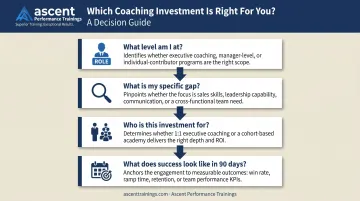
Four Questions to Clarify Your Path
Before committing to either approach, ask yourself:
- What level am I at? Your current role is the first filter for which coaching type fits.
- What's my specific gap? Strategic influence and organizational decisions point toward executive coaching; people leadership and self-awareness point toward leadership coaching.
- Who is this investment for? A single senior leader or a broader team changes both format and budget.
- What does success look like in 90 days? Define the outcome first, then choose the method built to deliver it.
Conclusion
Executive coaching and leadership coaching serve different people, at different stages, for different purposes. Neither is inherently better. The question is always which is right for the specific person, role, and organizational need in front of you.
Organizations that invest intentionally — sharpening executive performance at the top while building leadership strength throughout the pipeline — build cultures that sustain high performance over time. That outcome comes from making a deliberate choice about who needs what, then resourcing it accordingly.
Start by taking stock of where you are: what gap you're closing, and whether you need depth for one leader or breadth across a team. From there, the path becomes clearer — whether that's a structured program like the Ascent Leadership Academy or dedicated one-on-one executive coaching support.
Frequently Asked Questions
Is executive coaching the same as leadership coaching?
No. Both develop leadership capabilities and share some overlapping skills, but they serve different audiences. Executive coaching targets top-level leaders on strategic performance. Leadership coaching applies across organizational levels and focuses on skill-building, self-awareness, and interpersonal effectiveness.
What are the four types of coaching?
The four common types in professional settings are executive coaching, leadership coaching, business coaching, and performance coaching. Each serves a distinct purpose: executive coaching focuses on senior leadership strategy, leadership coaching on developing people leaders at any level, business coaching on commercial outcomes, and performance coaching on specific skill or output gaps.
What is the 70/30 rule in coaching?
The 70/30 rule refers to the principle that the coachee should speak approximately 70% of the time while the coach speaks 30%. It reflects the coaching philosophy that self-directed insight and discovery produce more durable change than direct instruction.
Who needs executive coaching?
Executive coaching is most valuable for C-suite leaders and senior VPs navigating complex challenges — new role transitions, restructuring, high-stakes stakeholder dynamics, or succession planning — who already have strong domain expertise and need a confidential space to reflect and sharpen their strategic approach.
Can a leader benefit from both executive and leadership coaching?
Yes. The two approaches are complementary. An executive might work with an executive coach on strategic leadership while also participating in a broader leadership development program to reinforce team-focused behaviors, organizational culture, and people leadership skills.
How long does executive or leadership coaching typically take to show results?
Executive coaching engagements typically run 6–12 months; leadership coaching programs range from a few weeks to several months depending on format. Meaningful behavior change often begins within 60–90 days when coaching is paired with consistent reinforcement and real-world application.