

This guide breaks down coaching rates by leadership level, the five factors that move costs most, how to evaluate ROI with real numbers, and the budgeting mistakes HR buyers make most often. Whether you're scoping a first coaching engagement or benchmarking a multi-leader program, the goal is a clear, confident decision.
TL;DR
- Executive coaching costs range from mid-manager programs to $60,000+ C-suite engagements, depending on seniority and structure
- The ICF Global Coaching Study puts the North American average coaching fee at $272 per hour across the profession; executive-level coaching runs considerably higher
- Five factors drive price most: coach credentials, leader seniority, solo vs. firm, customization depth, and delivery format
- ICF research citing PwC data shows coaching delivers an average 7x ROI — but only when outcomes are defined before the engagement starts
- Common budget mistakes include fixating on hourly rates and launching without baseline assessments or measurable goals
How Much Does Executive Coaching Cost?
Executive coaching doesn't have a fixed price, and treating it like a commodity leads to bad decisions. The same $400-per-hour rate could mean a credentialed coach with 20 years of C-suite experience or a newer coach working with first-time managers. Program length, what's included, and how the engagement is structured matter just as much as the hourly figure.
Comparing programs on hourly rate alone produces misleading results: fixed-fee packages include session prep, assessments, and stakeholder conversations that hourly billing doesn't cover.
Pricing by Leadership Level
The clearest organizing principle for coaching budgets is leadership tier. Higher seniority means greater organizational stakes, more complex decision-making, and coaches with deeper strategic experience to match.
| Leadership Level | Typical Hourly Rate | Typical 6-Month Program |
|---|---|---|
| Manager / Team Lead | $150–$300 | $3,000–$8,000 |
| Director / Head | $250–$500 | $8,000–$20,000 |
| VP / Senior Leader | $400–$750 | $15,000–$35,000 |
| C-Suite / CEO | $500–$3,500+ | $30,000–$60,000+ |
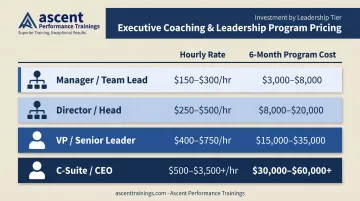
Note: The ICF Global Coaching Study reports a North American average of $272/hour across all coaching; the HBR survey of 140 leading coaches found executive coach fees ranging from $200 to $3,500/hour with a median of $500. Tiered ranges above reflect market context from these sources combined with engagement-level benchmarks.
Senior-level pricing reflects organizational stakes. A CEO's decisions ripple across the entire organization, so coaching at that level demands coaches who've operated in comparable high-stakes environments and can handle complexity that junior-level programs don't address.
Pricing by Engagement Model
Most formal organizational programs use fixed-fee packages, not hourly billing. Here's how the five main models compare:
- Hourly/per-session — Flexible, but doesn't include prep, assessments, or stakeholder work. Best for ad hoc support, not structured development
- Fixed-fee package — The standard for organizational programs. Covers a defined set of sessions, assessments, and between-session support over 3–6 months
- Monthly retainer — Common for ongoing advisory relationships with senior executives; provides continuous access without per-session billing friction
- Group coaching — Lower per-person cost for mid-level managers, with some trade-off in individual attention. Effective when peer learning adds value alongside the coaching
- Enterprise programs — Multi-leader engagements delivered through coaching firms or platforms, with program management and reporting infrastructure built in
The right model depends on who you're developing and what outcomes you're measuring — group programs scale efficiently across manager cohorts, while senior leaders typically need the depth that only 1:1 engagements provide.
Key Factors That Drive Executive Coaching Costs
Executive coaching costs are shaped by coach qualifications, program scope, and organizational context — factors that go well beyond session hours. Knowing what drives pricing helps HR buyers build accurate budgets and evaluate proposals on equal footing.
Coach Credentials and ICF Certification Level
The International Coaching Federation (ICF) credential system is the most transparent pricing indicator in the market. Three credential tiers reflect increasing coaching experience requirements:
| Credential | Minimum Coaching Hours | What It Signals |
|---|---|---|
| ACC (Associate Certified Coach) | 100+ hours | Foundational credential; suitable for emerging leader programs |
| PCC (Professional Certified Coach) | 500+ hours | Mid-market standard; broad organizational coaching |
| MCC (Master Certified Coach) | 2,500+ hours | Senior executive work; highest experience threshold |
Credential tier won't tell you the exact rate — coaches set their own fees — but it gives HR buyers a structured basis for comparing candidates and understanding why rates differ across proposals.
Seniority of the Leader Being Coached
This is the single strongest pricing predictor. Senior leaders need coaches with deeper strategic, organizational, and interpersonal experience — not just credential hours, but real operating context at comparable levels.
HR teams that apply a single coaching rate organization-wide consistently underbudget for senior leaders and overspend for manager-level programs. Budget per leader based on seniority tier, not a blanket rate.
That seniority match also shapes the next decision: whether to engage a solo coach or a coaching firm. The answer depends on what the engagement actually requires.
Solo Coach vs. Coaching Firm
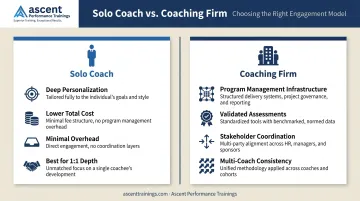
- Solo coaches offer deep personalization and often lower total cost — best when one-to-one depth is the priority and program management overhead is minimal
- Coaching firms add infrastructure: program management, validated assessments, stakeholder coordination, progress reporting, and multi-coach consistency across large cohorts. They carry a pricing premium, but organizations running programs across multiple leaders often find that structure worth the cost
Degree of Customization and Program Length
Standard programs — validated tools, established frameworks, 3–6 months — cost less than heavily tailored engagements with custom diagnostics, 360-degree feedback, stakeholder interviews, and longer durations running 6–12 months.
One consistent mistake: cutting the baseline assessment to reduce cost. The assessment is what the coach uses to tailor the program and what the organization uses to measure progress. Without that diagnostic foundation, the engagement lacks direction — and the results become difficult to measure or justify at renewal.
Geography and Delivery Format
Coaching rates in major US markets — New York, San Francisco, Washington DC — run meaningfully higher than in smaller cities, reflecting both cost-of-living differentials and the concentration of senior executive clients in those markets.
Virtual delivery has made geography less of a factor than it once was. Key delivery considerations that still affect cost:
- Virtual sessions open access to coaches in any market — a client in Denver or Houston can work with a New York-based coach without premium travel costs
- In-person delivery still commands a rate premium for senior leaders who prefer it
- Travel costs can add meaningfully to total program spend if on-site sessions are required
The ROI of Executive Coaching: Making the Business Case
ROI is the central justification for the investment — not a secondary consideration. Organizations that evaluate coaching purely on cost often reject programs that would have paid for themselves several times over, while approving cheaper alternatives that deliver no measurable change.
The Numbers Behind the ROI
Two studies anchor most serious ROI conversations:
The ICF/PwC finding: According to a 2024 ICF article citing a global survey by PricewaterhouseCoopers and the Association Resource Center, coaching delivers an average return of 7x the cost of the coaching investment, with 87% of respondents agreeing that executive coaching delivers high ROI.
The MetrixGlobal case study: A study of 43 leadership development participants at a Fortune 500 firm found 529% ROI excluding retention benefits — meaning the financial impact of improved leadership performance alone more than quintupled the program cost.
The cost-of-inaction math is just as concrete. SHRM reported in 2025 that replacing an employee costs between 50% and 200% of their annual salary, depending on seniority. A VP earning $180,000 represents a replacement cost of $90,000–$360,000.
A mid-range executive coaching program for that same leader at $15,000–$25,000 looks very different against that benchmark.
Measuring ROI Before It Happens
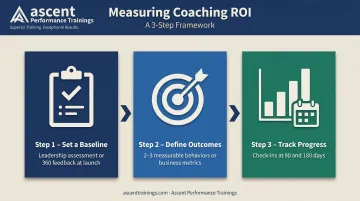
Organizations that see the clearest ROI define measurable outcomes before the program starts. The structure is straightforward:
- Set a baseline at launch — leadership assessment, 360-degree feedback, or performance data that reflects the leader's starting point
- Define 2–3 measurable outcomes — specific behaviors, business metrics, or team performance indicators the coaching should move
- Track at 90 and 180 days — check-ins that document progress against the baseline and give the coach data to adjust course
Programs that skip this structure still deliver real value, but HR cannot quantify or defend that value at the next budget cycle. That's a meaningful problem when leadership development competes for budget annually.
Ascent Performance Trainings addresses this directly through its 8-week post-training reinforcement model: weekly video touchpoints reinforce core concepts, while monthly one-on-one coaching sessions give participants personalized support to apply skills in real-world situations. That structured follow-through is what converts initial coaching conversations into lasting behavior change — and gives organizations the documented evidence to justify the next investment.
Executive Coaching Cost Breakdown: What You're Actually Paying For
The quoted coaching fee rarely tells the full story. Build your budget around three distinct components to avoid mid-engagement surprises.
1. The coaching fee itself This covers the coach's time — sessions, prep, and between-session communication. Whether priced hourly, as a fixed package, or as a monthly retainer, this is the visible cost most buyers focus on.
2. Diagnostic and assessment tools Leadership assessments, 360-degree feedback instruments, EQ inventories, and DISC profiles are often quoted separately from the coaching fee. Some coaches bundle them; others don't. Ask before you sign — assessments typically range from a few hundred to several thousand dollars depending on the instrument and number of raters involved.
3. Internal HR and program management time This cost never appears on an invoice. Coordinating the engagement, aligning it to business objectives, briefing stakeholders, and tracking progress all consume internal bandwidth — especially for multi-leader programs. For enterprise rollouts, internal coordination can add 15-20% to the effective cost of a program.
Costs also vary by when they hit. Map your budget to three timing categories:
- One-time costs: Initial assessment, program setup, onboarding
- Recurring costs: Session fees, monthly retainer, between-session support, progress reporting
- Periodic costs: Mid-program 360-degree re-assessment, renewal or extension fees
A program priced at $500 per session can easily run $15,000–$25,000 all-in once assessments, internal time, and renewal cycles are counted. That's the number worth putting in your budget.
How to Budget for Executive Coaching (and Avoid Costly Mistakes)
Effective coaching budgets match the investment to the leader's seniority, the organizational stakes, and the full scope of the engagement — not just the lowest available rate. Three procurement mistakes consistently undermine that logic.
Key Budgeting Mistakes to Avoid
Chasing the Lowest Hourly Rate
Hourly rates are nearly meaningless for comparing formal programs. A $300/hour coach running a 6-month package that includes assessments, stakeholder conversations, and structured reporting may deliver more value than a $500/hour coach billing pure session time. Always ask for a complete fee breakdown before comparing proposals.
Skimping on the Baseline Assessment
Cutting the diagnostic assessment is the most counterproductive cost-saving move in coaching procurement. It's the foundation the coach builds on and the benchmark the organization uses to measure progress.
Remove it, and you've stripped out both the tailoring mechanism and the measurement baseline. Programs without diagnostic data are harder to run, impossible to evaluate, and vulnerable at every future budget review.
Starting Without Defined Outcomes
Coaching without defined outcomes cannot demonstrate ROI. It may still change the leader's thinking and behavior — but if HR can't show it, it won't survive the next budget cycle.
Effective programs begin with a direct connection between individual development goals and specific performance improvements the organization can track. Ascent Performance Trainings structures every engagement around that alignment from day one, which is what converts a coaching expense into a defensible investment.
Frequently Asked Questions
How much does a leadership coach cost?
Leadership coaches typically charge $150–$500/hour for manager-level work, with C-suite coaches running $500–$3,500/hour based on experience and credential level. For total program costs by seniority tier, see the pricing table above.
What is the 70/30 rule in coaching?
The 70/30 principle holds that the client should speak roughly 70% of the session while the coach speaks 30%. This keeps the focus on the leader's own thinking and problem-solving rather than coach-delivered advice — coaching draws out answers; consulting delivers them.
What is typically included in an executive coaching program?
Standard programs include 1:1 sessions over 3–6 months, a baseline leadership assessment, and progress measurement. Higher-investment programs add 360-degree feedback, stakeholder interviews, and structured between-session support.
How do companies fund executive coaching?
Most organizations fund coaching through L&D or leadership development budgets, with spend tiered by seniority. Enterprise programs are sometimes folded into broader people-development initiatives or executive compensation packages.
Is executive coaching worth it for mid-level managers?
Yes — when the engagement is built around defined outcomes. Group or fixed-fee programs for managers deliver strong ROI at a fraction of executive-tier costs. The difference between effective coaching and expensive check-ins comes down to outcome definition and follow-through.